How Many Vehicles Do I Need to Qualify for a Ford FIN Code?
One of the most common questions businesses ask about Ford fleet purchasing is how many vehicles they need before they can qualify for a Ford FIN Code.
The answer is not simply “15 vehicles.”
Ford currently provides several ways for a commercial business to meet its fleet eligibility requirements. Your company may qualify based on recent new-vehicle purchases or leases, the number of vehicles already in your fleet, or certain heavy commercial vehicle requirements.
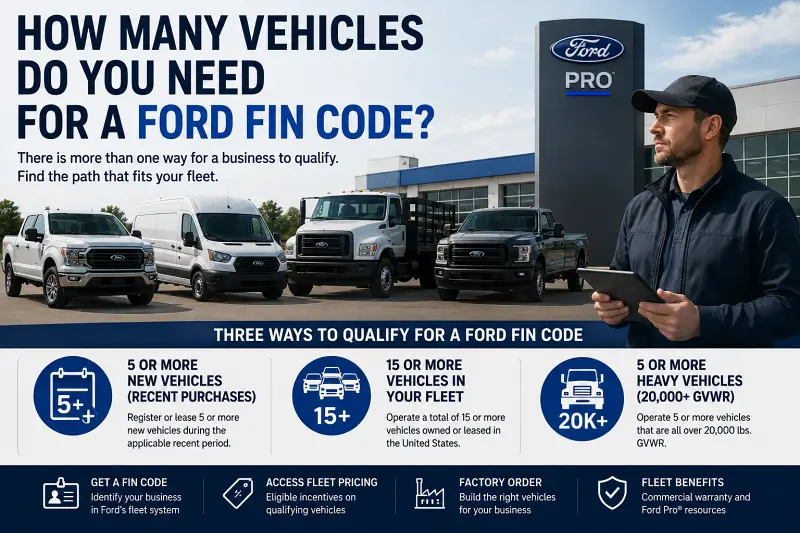
How Many Vehicles Are Required for a Ford FIN Code?
Under Ford’s current commercial fleet requirements, a business may qualify through one of several paths.
One common route is having registered or leased 5 or more new vehicles for use in the business during Ford’s applicable recent qualification period.
Another route is currently operating a fleet of 15 or more vehicles owned or leased in the United States.
Ford also has a qualification route for certain businesses operating 5 or more vehicles that are all over 20,000 lbs. GVWR.
You Do Not Necessarily Need 15 Vehicles
The 15-vehicle requirement is only one way a commercial business may qualify for a Ford FIN Code.
A business with a smaller existing fleet may still qualify if it has enough recent new-vehicle purchase or lease activity.
That distinction is especially important for growing contractors and service businesses that may operate fewer than 15 vehicles but replace or add several vehicles over a relatively short period.
Example
A company may operate only 8 work vehicles today.
If that company has registered or leased enough new qualifying vehicles during Ford’s applicable recent qualification period, it may still meet Ford’s commercial FIN requirements.
The existing fleet does not always have to contain 15 vehicles.
5 or More Recent New-Vehicle Purchases or Leases
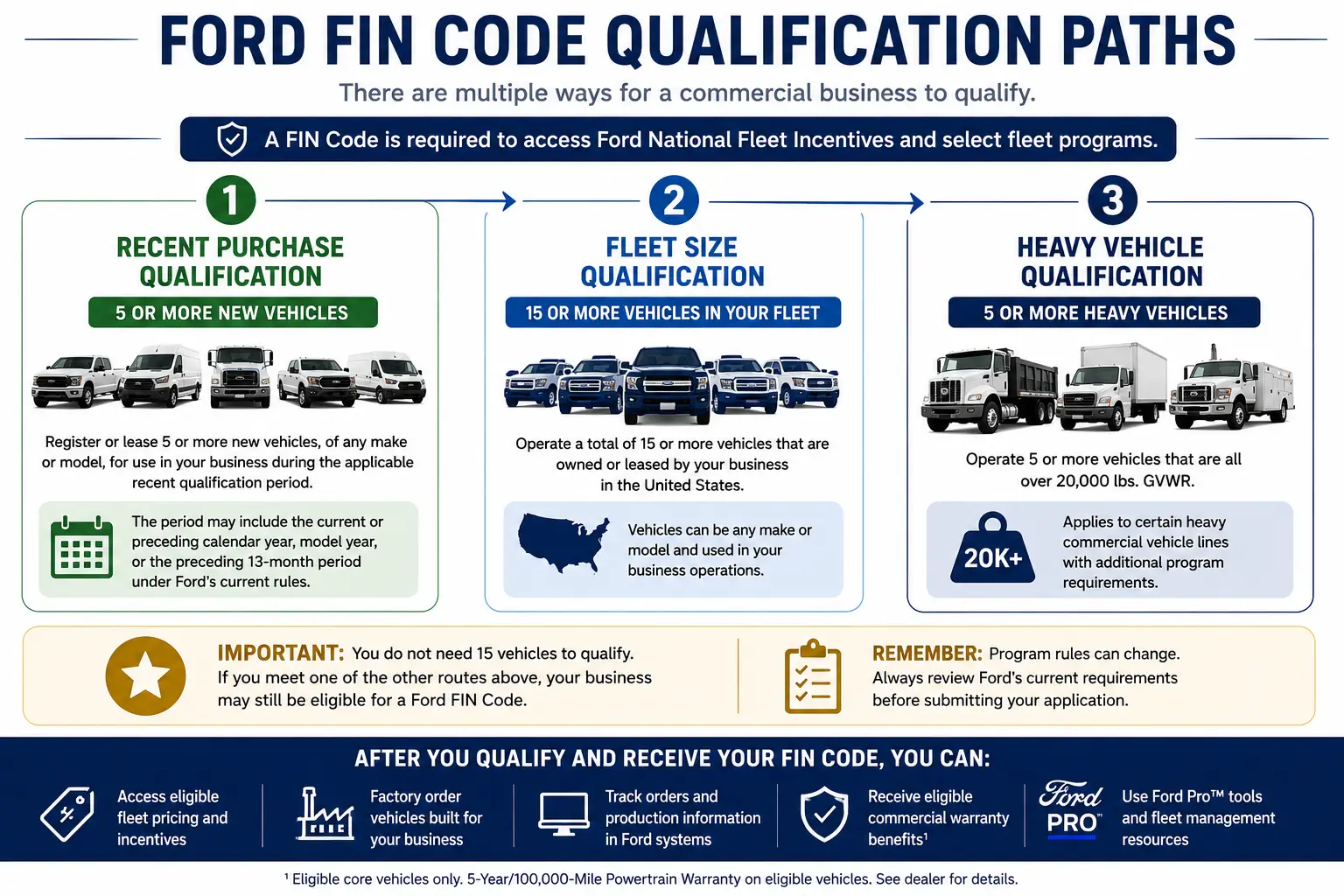
Ford currently allows commercial end-users to qualify when they have registered or leased 5 or more new vehicles, of any make or model, for use in their operation during the applicable qualification period.
Ford’s current program language includes the current or preceding calendar or model year, or the preceding 13-month period.
This route can be particularly useful for businesses that are actively expanding or replacing vehicles but have not yet reached a 15-vehicle fleet.
The Vehicles Do Not All Have to Be Ford Vehicles
Ford’s current commercial FIN requirements state that the qualifying new vehicles can be any make or model.
The important question is whether the vehicle activity meets Ford’s current qualification requirements and can be properly documented.
Currently Operate 15 or More Vehicles
A commercial business can also meet Ford’s current FIN requirements by operating a fleet of 15 or more vehicles.
Those vehicles may be owned or leased by the business and can be any make or model.
This route can make sense for established businesses that already operate a larger fleet even if they have not purchased five new vehicles recently.
The Fleet Can Include:
- Ford vehicles
- Other vehicle makes
- Owned vehicles
- Leased vehicles
- Trucks
- Vans
- Other qualifying fleet vehicles
Certain Heavy-Vehicle Fleets Can Qualify With 5 Vehicles
Ford also provides a special commercial qualification route for certain heavy-vehicle fleets.
Under Ford’s current rules, a business may qualify by operating a fleet of 5 or more vehicles that are all over 20,000 lbs. GVWR.
Ford’s current National Fleet Incentive program identifies this route as applicable to certain heavy commercial vehicle lines, including F-650/F-750 and related program applications.
GVWR Matters Here
This qualification route is different from simply owning five normal pickups or vans.
The vehicles must meet the heavy-vehicle requirements specified by Ford’s current program.
Ford FIN Code Qualification Paths
The right qualification path depends on your current fleet, recent vehicle activity and the type of commercial vehicles your business operates.
Do the Vehicles Have to Be Ford Vehicles?
No.
Ford’s current commercial FIN qualification language allows vehicles of any make or model to be considered under the applicable qualification routes.
That means a business does not necessarily have to operate an all-Ford fleet before applying for a Ford FIN Code.
For Example
A contractor could currently operate a combination of Ford, Chevrolet, Ram, Toyota or other qualifying commercial vehicles.
What matters is whether the fleet meets Ford’s current requirements and the business can document that eligibility.
Do Leased Vehicles Count Toward Ford FIN Eligibility?
Yes, leased vehicles can count under Ford’s current commercial qualification requirements when they meet the applicable program rules.
Ford’s current eligibility language specifically refers to vehicles that are either owned or leased.
For a business that leases some vehicles and owns others, both groups may therefore be relevant when reviewing FIN eligibility.
Can a Small Business Qualify for a Ford FIN Code?
Yes.
Ford fleet eligibility is not limited to national corporations with hundreds of vehicles.
A small or midsize business may qualify if its fleet or recent vehicle activity meets one of Ford’s current commercial qualification routes.
This can make FIN eligibility relevant to contractors, service businesses and growing companies much earlier than many business owners expect.
Businesses Worth Reviewing Can Include:
- HVAC contractors
- Plumbing companies
- Electrical contractors
- General contractors
- Roofing companies
- Landscaping businesses
- Pest-control companies
- Delivery businesses
- Property maintenance companies
- Other growing commercial fleets
What If I Plan to Buy 5 Vehicles Next Year?
Planned future purchases are important for fleet planning, but FIN eligibility should be reviewed against Ford’s current qualification rules at the time of the application.
If your company expects to add several vehicles, it is worth reviewing the situation before the purchases become urgent.
Depending on the company’s existing fleet and recent purchasing activity, the business may already qualify through another route.
Planning Ahead Can Help You:
- Review FIN eligibility early
- Plan factory orders
- Review fleet incentives
- Coordinate commercial upfits
- Prepare financing
- Forecast replacement timing
What Documentation May Be Needed?
When applying for a FIN Code, the business may need to provide documentation that supports the qualification route being used.
The documents needed can vary depending on whether the application is based on recent vehicle activity, existing fleet size or another qualifying fleet category.
Vehicle Records
Registration, lease or other vehicle information may be used to document the fleet.
Business Information
Ford may require information verifying the company and its commercial operation.
Qualification Support
Documentation should support the specific FIN qualification route being used.
Start With the Qualification Route
It is usually easier to first determine how your business appears to qualify and then gather the documents needed for that route.
How Do I Apply for a Ford FIN Code?
Once it appears the business meets Ford’s eligibility requirements, the next step is completing the FIN enrollment process.
1. Review Your Fleet
Determine your current fleet size, recent new-vehicle activity and vehicle types.
2. Identify the Qualification Route
Determine which of Ford’s current commercial FIN requirements your business appears to meet.
3. Gather Documentation
Prepare the supporting vehicle and business records needed for the application.
4. Submit the FIN Application
Complete the Ford fleet enrollment process with accurate business and fleet information.
5. Ford Reviews the Application
Ford verifies the submitted information and may request additional documentation if needed.
6. Receive Your FIN Code
If approved, Ford sends the FIN information and welcome materials to the business.
What Does a Ford FIN Code Give Your Business Access To?
An approved FIN identifies your company as a Ford fleet customer and can connect the business with applicable fleet programs and resources.
Fleet Incentives
Qualified FIN customers can access applicable fleet-specific incentives on eligible vehicles.
Factory Ordering
Plan vehicles around the configurations and timing required by the business.
Order Information
Ford Pro provides FIN customers access to applicable order-status and production-availability information.
Commercial Warranty
Eligible FIN customers can receive Ford’s extended commercial powertrain coverage on qualifying vehicle lines.
Ford Pro Resources
Access available tools and information designed for commercial fleet customers.
Long-Term Planning
Coordinate future orders, replacements, upfits and financing as part of a larger fleet strategy.
Eligible FIN Customers Can Receive Extended Powertrain Coverage
Ford currently provides qualifying commercial customers with a valid FIN Code increased powertrain warranty coverage of 5 years or 100,000 miles, whichever occurs first, on certain eligible vehicle lines.
Current eligible lines include specified F-150, Super Duty, Transit, E-Series and stripped-chassis applications, subject to Ford’s current exclusions and warranty terms.
Learn More About FIN BenefitsImportant
The warranty benefit applies only to qualifying vehicles and customers with a valid FIN.
Vehicle eligibility and exclusions should always be checked against Ford’s current warranty terms.
FIN Vehicles Also Have In-Service Requirements
Businesses using Ford fleet programs should also understand the minimum in-service requirements.
Ford’s current commercial fleet program requires vehicles acquired using a FIN Code to generally remain in service for at least 12 months or 20,000 miles, whichever comes first.
Failure to follow applicable fleet program requirements can affect incentives or FIN status, so current program rules should always be reviewed before purchasing or disposing of fleet vehicles.
Does Qualifying for a FIN Code Mean Every Ford Is Cheaper?
No.
A FIN Code makes an approved business eligible for applicable fleet programs, but fleet incentives vary by model, model year, program and timing.
Retail incentives also change, which means the best purchase structure should be reviewed before every transaction.
Compare Retail vs. Fleet PricingFIN Eligibility Is Only One Part
The vehicle, available incentives, configuration, financing and long-term fleet plan should all be considered before deciding how to purchase.
Learn More About Ford FIN Codes and Fleet Purchasing
Ford FIN Code Explained
Learn what a FIN Code is, how it works and why a qualified business may want one.
Read the FIN Code Guide →Qualifying for Fleet Pricing
Learn how FIN eligibility fits into Ford fleet purchasing and pricing.
Learn About Fleet Pricing Eligibility →Retail vs. Fleet Pricing
Compare normal retail purchasing with Ford’s fleet purchasing path.
Compare Retail and Fleet →Ford FIN Code
Review your business’s FIN eligibility and learn how to begin the application process.
Review FIN Eligibility →Factory Ordering
Learn how to order Ford commercial vehicles around your company’s requirements.
How to Factory Order a Ford →Fleet Planning
Plan future orders, replacements, financing and vehicle requirements.
Explore Fleet Planning →Ford FIN Code Vehicle Requirement FAQ
How many vehicles do I need for a Ford FIN Code?
Ford currently provides several commercial qualification routes. A business may qualify with five or more qualifying recent new-vehicle purchases or leases, by operating a fleet of at least 15 vehicles, or through certain heavy-vehicle fleet requirements.
Do I need 15 vehicles to qualify?
No. Fifteen vehicles is only one qualification route. A business may qualify with fewer vehicles if it meets another current Ford commercial FIN requirement.
Do all of my fleet vehicles have to be Fords?
No. Ford’s current commercial FIN eligibility requirements allow qualifying vehicles of any make or model.
Do leased vehicles count?
Yes. Ford’s current requirements include qualifying vehicles that are owned or leased, subject to the applicable program rules.
Can a small business qualify for a FIN Code?
Yes. Small and midsize businesses can qualify when they meet one of Ford’s applicable commercial fleet eligibility requirements.
What if my business has fewer than 15 vehicles but recently bought 5 new vehicles?
The business may meet Ford’s recent new-vehicle activity qualification route if those purchases or leases satisfy Ford’s current timing and program requirements.
Does getting a FIN Code guarantee fleet discounts?
No. A FIN Code makes an approved business eligible for applicable fleet programs, but incentives vary by vehicle and program.
Can you help me determine whether my business qualifies?
Yes. I can review your current fleet, recent vehicle activity and upcoming purchase plans to help determine which FIN qualification route may apply and what documentation may be needed.
Let Me Review Your Fleet Before You Apply
If your company has recently purchased vehicles, currently operates a commercial fleet or expects to add vehicles soon, I can help review your situation and determine whether it appears to meet Ford’s current FIN requirements.