Ford Fleet Planning & Consultation for Businesses
Build a vehicle plan around the way your company actually operates. We can review your current fleet, employee needs, workload, mileage, replacement schedule and future vehicle requirements before deciding what to order.
The goal is to help your business make better vehicle decisions today while also planning what the fleet may need over the next several months and beyond.
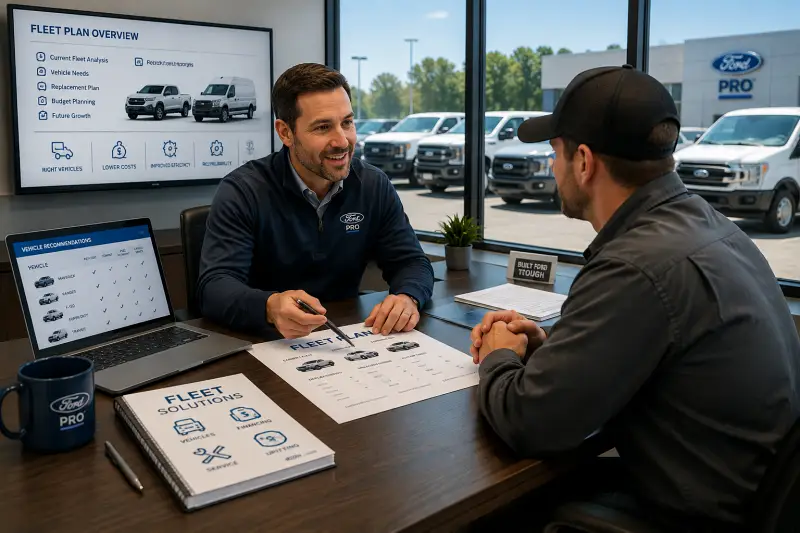
What Should Your Business Be Planning?
Fleet planning brings the vehicle, replacement schedule, financing, equipment and long-term operating strategy together.
Current Fleet
Review the vehicles you operate today and how each one is being used.
Fleet Needs Analysis ↓Vehicle Selection
Match Ford trucks and vans to individual employees and workloads.
Choose Vehicles ↓Replacement Planning
Identify vehicles that may need replacement before downtime becomes a problem.
Replacement Strategy ↓Commercial Upfits
Plan shelving, racks, service bodies and other equipment with the vehicle.
Upfit Planning ↓Financing
Review commercial financing, TRAC leasing and fleet credit resources.
Financing Strategy ↓Ford Telematics
Larger fleets can use connected data to better understand utilization and vehicle operation.
Fleet Technology ↓Fleet Consultation
Bring everything together in a review of your current and future fleet needs.
Request a Consultation ↓What Is a Fleet Planning Consultation?
A fleet planning consultation is a review of how your business currently uses its vehicles and what it expects to need in the future.
Instead of starting with a particular truck, van or trim level, we start with the work. That can include employee driving patterns, tools and equipment, payload, towing, annual mileage, replacement cycles and future growth.
From there, we can begin developing a practical vehicle strategy that connects today’s needs with future orders, replacements, financing and fleet-management resources.
Fleet planning is not about putting every employee in the same vehicle. It is about matching vehicles to jobs while giving the company a clearer picture of future vehicle costs and replacement needs.
Businesses That May Benefit
- Contractors
- HVAC companies
- Plumbing companies
- Electrical contractors
- Landscaping companies
- Property maintenance companies
- Delivery businesses
- Service companies
- Construction companies
- Municipal and government fleets
- Businesses with multiple locations
- Companies replacing vehicles regularly
Build the Fleet Plan Around the Business
The right vehicle recommendation depends on much more than the number of vehicles your company operates.
Current Fleet
Review vehicles currently in service, their age, mileage, condition and how each vehicle is being used.
Employee Use
Determine which employees drive the vehicles, how much time they spend on the road and what their daily job requires them to carry or tow.
Mileage & Fuel Usage
Consider annual mileage, local driving, highway use, stop-and-go conditions and how fuel usage can affect operating cost.
Payload & Towing
Include employees, tools, materials, equipment, accessories and expected trailer weight when determining required vehicle capability.
Replacement Timing
Identify aging or high-mileage vehicles that may need replacement before maintenance costs, downtime or reliability become larger problems.
Future Growth
Consider new employees, additional locations, expanding service areas and other changes that may create vehicle needs over the next 6–12 months and beyond.
Choosing the Right Ford Vehicle for the Job
A mixed fleet may use several different Ford vehicles because different employees have different capability needs.
Ford Maverick
Consider Maverick for lighter-duty applications where maneuverability, everyday driving and pickup-bed utility are major priorities.
Build & order Ford Maverick →Ford Ranger
Ranger can make sense when the business needs more traditional truck capability while still preferring a midsize footprint.
Explore Ford Ranger →Ford F-150
F-150 provides a wider range of configurations for businesses requiring additional towing, payload, cab choices and full-size pickup capability.
Build & order Ford F-150 →Ford Super Duty
Super Duty is intended for heavier towing, payload, chassis-cab applications and commercial bodies or equipment that exceed light-duty truck requirements.
Build & order Ford Super Duty →Ford Transit
Transit can be configured for service, delivery, equipment storage, passenger transportation and specialized commercial upfit applications.
Build & order Ford Transit →Commercial Vehicle Selector
Answer a few questions about towing, payload, cargo, passengers and daily use to help narrow the Ford vehicles worth reviewing.
Use the Vehicle Selector →A mixed fleet can often make more sense than a one-size-fits-all approach. An estimator may need a Maverick, a field technician may need a Ranger or Transit, and another employee may require an F-150 or Super Duty based on workload.
Look Beyond the Initial Purchase Price
The lowest purchase price does not always create the lowest operating cost over the life of a fleet vehicle.
Acquisition Cost
Compare vehicle pricing, fleet programs, equipment and acquisition structure before deciding which configuration makes sense.
Fuel Usage
A vehicle driven thousands of miles each year can create significant fuel costs during its useful life.
Maintenance
Consider expected maintenance, service requirements and how vehicle age may affect future repair expenses.
Downtime
A vehicle that is frequently unavailable can create costs beyond the repair bill by disrupting employees and jobs.
Capability
Too little vehicle can create workload limitations, while substantially more capability than required can increase acquisition and operating costs.
Replacement Cycle
Establishing an expected ownership period can help the business anticipate purchases rather than reacting only after vehicles fail.
Build a Vehicle Replacement Forecast
Waiting until a work vehicle fails can leave a business searching dealer inventory for whatever happens to be available at that moment.
A replacement forecast gives the business a better idea of which vehicles may need replacement over the coming months so factory ordering can be considered before the need becomes urgent.
- Review vehicle age and mileage
- Identify high-maintenance vehicles
- Consider upcoming employee growth
- Plan around expected replacement dates
- Review factory ordering lead times
- Update the forecast as business needs change
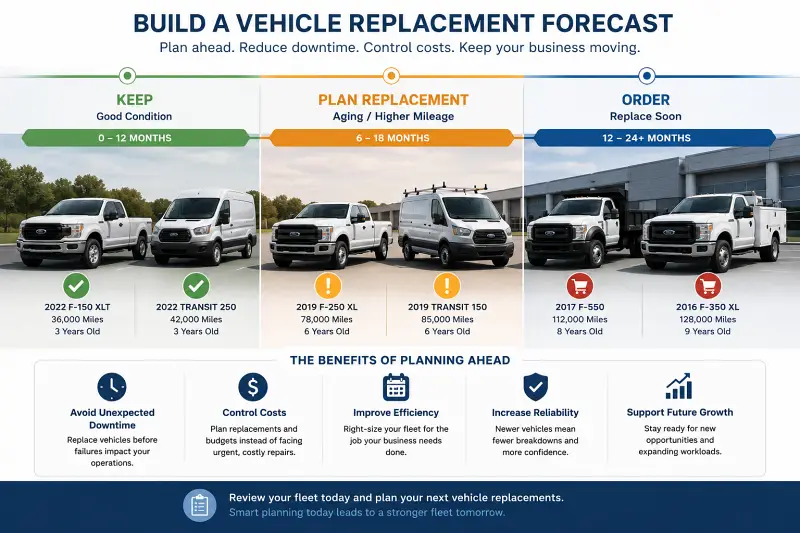
Think About the Next 6–12 Months
Fleet planning should include vehicles the business expects to need in the future, not only vehicles that need replacement today.
Vehicles Needed Now
Identify immediate replacement or fleet expansion needs.
Upcoming Replacements
Review vehicles likely to reach replacement mileage or age during the coming year.
Business Growth
Estimate vehicle demand from new employees, contracts, locations or expanded service areas.
Factory Order Timing
Determine when orders may need to be placed based on expected vehicle requirements and production timing.
Plan the Vehicle and Commercial Upfit Together
For many businesses, the vehicle is only the starting point. The finished work vehicle may also need shelving, ladder racks, tool storage, a service body or other commercial equipment.
Those additions can affect payload, dimensions, storage, electrical requirements and even which base vehicle should be ordered.
That is why commercial equipment should be considered during fleet planning rather than after the vehicle has already arrived.
Consider the Completed Vehicle
- Shelving and storage
- Ladder racks
- Toolboxes
- Service bodies
- Utility bodies
- Dump bodies
- Electrical equipment
- Permanent work equipment
Plan How the Business Will Acquire Its Vehicles
Vehicle configuration and financing should support the broader fleet strategy.
Commercial Financing
Traditional commercial financing may make sense when the company intends to own and operate vehicles for a longer period.
Explore Commercial Financing →TRAC Leasing
An open-ended commercial TRAC lease may be worth reviewing for vehicles with high mileage, commercial use and defined replacement cycles.
Explore TRAC Leasing →Ford Commercial Line of Credit
Businesses expecting recurring vehicle purchases or fleet growth may want to review Ford Commercial Line of Credit as part of future acquisition planning.
Explore Ford CLOC →Fleet financing decisions should consider the completed work vehicle, including applicable upfit costs, expected mileage and how long the vehicle is expected to remain in service.
Use Fleet Data to Improve Future Planning
Fleet planning becomes more useful when the business has a better understanding of how its vehicles are actually being used.
For larger fleets, Ford Telematics can provide connected vehicle information that can help businesses review utilization, mileage, maintenance and driver activity.
That information can also help support future replacement and vehicle-selection decisions.
Explore Ford TelematicsUnderstand How Vehicles Are Being Used
- Vehicle mileage
- Vehicle utilization
- Idle time
- Maintenance information
- Vehicle health
- Driver activity
- Operating patterns
Turn the Fleet Plan Into an Ordering Strategy
Once vehicle requirements and timing are understood, future purchases can become planned fleet orders rather than last-minute vehicle searches.
Ford FIN Code
Qualified Ford fleet customers may have access to applicable fleet programs and purchasing opportunities.
Learn About FIN Codes →Factory Fleet Ordering
Configure vehicles around the employee’s actual job rather than limiting purchases to dealer inventory.
Explore Factory Ordering →Ford Fleet Orders
Coordinate current and future Ford vehicle orders through a commercial account manager.
Explore Ford Fleet Orders →Upfit Coordination
Plan shelving, racks, commercial bodies and equipment before vehicles enter service.
Explore Vehicle Upfits →Financing & CLOC
Review acquisition methods and commercial credit based on the company’s larger fleet strategy.
Explore Fleet Financing →Additional Fleet Resources
Continue into tools and resources that can help manage the complete vehicle life cycle.
Explore Additional Resources →The Fleet Planning Process
The process starts with understanding your business before recommending vehicles.
Review the Fleet
Discuss current vehicles, employees, mileage, workloads and replacement concerns.
Identify Requirements
Determine payload, towing, cargo, passenger, driving and equipment requirements.
Compare Options
Review Ford vehicles, configurations, upfits, financing and fleet resources.
Build the Forecast
Identify current needs, upcoming replacements and potential fleet growth.
Build the Order Strategy
Decide which vehicles may need to be purchased from inventory and which should be factory ordered.
Review the Plan Over Time
Update the strategy as mileage, employees, contracts and fleet requirements change.
Start Exploring Your Fleet Needs
These tools can help you think through different parts of the fleet before or after a consultation.
Commercial Vehicle Selector
Compare Ford vehicles based on how the business needs the vehicle to work.
Use Vehicle SelectorFleet Replacement Planner
Review current vehicles and identify which may need replacement planning.
Use Replacement PlannerCommercial Loan Calculator
Estimate payments using vehicle cost, upfit cost, term and rate assumptions.
Estimate a PaymentTRAC Lease Estimator
Explore an estimated commercial TRAC lease based on vehicle price, term and residual assumptions.
Estimate TRAC LeaseFleet Planning & Consultation Questions
What is included in a fleet needs analysis?
A fleet needs analysis can review current vehicles, employee roles, annual mileage, payload, towing, equipment, vehicle age, replacement schedules and expected future vehicle requirements.
How far ahead should a business plan vehicle replacements?
Many businesses benefit from reviewing vehicle needs several months in advance, particularly when factory ordering may be considered. Timing depends on the vehicle, configuration, production schedules and the business’s replacement needs.
Can you help determine which Ford vehicle we need?
Yes. Vehicle selection can be based on employee use, mileage, tools and equipment, towing, payload, passengers and other operating requirements.
You can also start with the Commercial Vehicle Selector .
Can a business use different vehicles within the same fleet?
Yes. A mixed fleet can make sense when employee roles differ. Some employees may need a Maverick while others require a Ranger, F-150, Super Duty or Transit.
Can you help with Ford FIN Code eligibility?
Yes. If your business does not currently have a Ford FIN Code, we can review your fleet needs and discuss whether the business may qualify.
Can fleet planning include financing and leasing?
Yes. Commercial financing, TRAC leasing and other fleet credit resources can be reviewed alongside vehicle use, ownership period and replacement plans.
Can fleet planning include commercial upfits?
Yes. Shelving, racks, service bodies and other equipment can affect vehicle configuration, payload and cost, so the upfit should often be considered before the vehicle is ordered.
Can Ford Telematics be part of fleet planning?
For larger fleets, connected vehicle information can help the business better understand mileage, utilization, maintenance and other operating patterns that may influence future vehicle decisions.
Is a fleet consultation only for large companies?
No. Fleet planning can be useful for small businesses operating several vehicles as well as larger companies managing substantial vehicle fleets.
Does a fleet consultation obligate me to buy vehicles?
The purpose of the consultation is to review the business’s needs and provide useful planning information. The vehicle strategy can then be used when the business is ready to move forward.
Let’s Review Your Current and Future Fleet Needs
Tell me about the vehicles your company operates today, what your employees need them to do and what you expect to need over the next 6–12 months.
There is no cost for the initial fleet review. The goal is to give your business a clearer picture of vehicle needs, replacement timing, ordering options and other Ford fleet resources worth considering.
Tell Me About Your Fleet
Complete the short form below and I can review your current and future vehicle needs with you.