Ford Factory Order Wait Times: How Long Does It Take?
One of the first questions businesses ask after deciding to factory order a Ford is simple: How long will it take to get the vehicle?
Unfortunately, there is no single Ford factory-order wait time that applies to every truck, van or commercial vehicle.
The actual timeline can depend on the model, configuration, order-bank status, production scheduling, parts availability, transportation and whether the vehicle requires a commercial upfit before it is ready for work.
Understanding those stages can help your business plan orders earlier and reduce the risk of needing a vehicle before it is available.
How Long Does a Ford Factory Order Take?
There is no universal Ford factory-order wait time. Some vehicles and configurations can move through the process faster than others, while certain commercial vehicles or specialized configurations can require significantly more time.
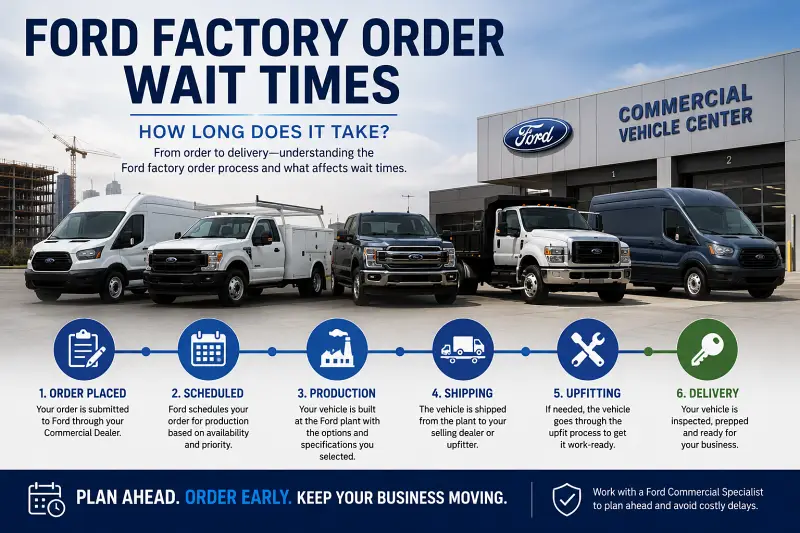
A Ford factory order generally needs to move through several stages: order submission, scheduling, production, transportation, possible commercial upfitting, dealer preparation and final delivery.
The best approach for a business is to plan around the complete process rather than relying on a generic estimate expressed only in weeks.
The Ford Factory Order Timeline
A factory order does not go directly from the dealership to the assembly line. Several things need to happen before the vehicle reaches your business.
1. Order Submitted
Your dealer submits the approved vehicle configuration into Ford’s ordering system while ordering is available for that model.
2. Waiting for Scheduling
Ford reviews available production capacity, vehicle configuration and other scheduling considerations before assigning the vehicle to production.
3. Vehicle Scheduled
Once selected for production, the order begins moving toward an assigned production window.
4. Production
The vehicle moves through Ford’s manufacturing process with the factory options included in the order.
5. Transportation
After production, the vehicle must travel from the assembly plant to the dealership, upfitter or another destination in the delivery process.
6. Upfit & Final Delivery
Commercial equipment may need to be installed before dealer preparation and final delivery to your business.
The Factory Order Is Submitted
The process starts by determining exactly which vehicle your business needs.
Depending on the Ford model, this can include the trim, engine, drivetrain, cab configuration, bed or body, packages, colors, individual options and commercial equipment requirements.
Once the final build is reviewed and approved, the dealership can submit the order when the applicable order bank is open.
How to Factory Order a FordBefore the Order Is Submitted
- Choose the correct vehicle
- Review the configuration
- Confirm towing and payload needs
- Plan commercial upfits
- Review applicable fleet programs
- Review financing or leasing
- Approve the final build
Order Submission Does Not Mean Immediate Production
An important distinction is the difference between an order being submitted and an order being scheduled for production.
Once Ford receives the order, it still needs to be selected for production.
Scheduling can depend on production capacity, the model being ordered, vehicle configuration, available parts and other manufacturing considerations.
This Is Why Two Orders Can Have Different Timelines
Two businesses may order the same general Ford model around the same time but receive different production schedules because the configurations, options or production requirements are different.
What Affects Ford Factory Order Wait Times?
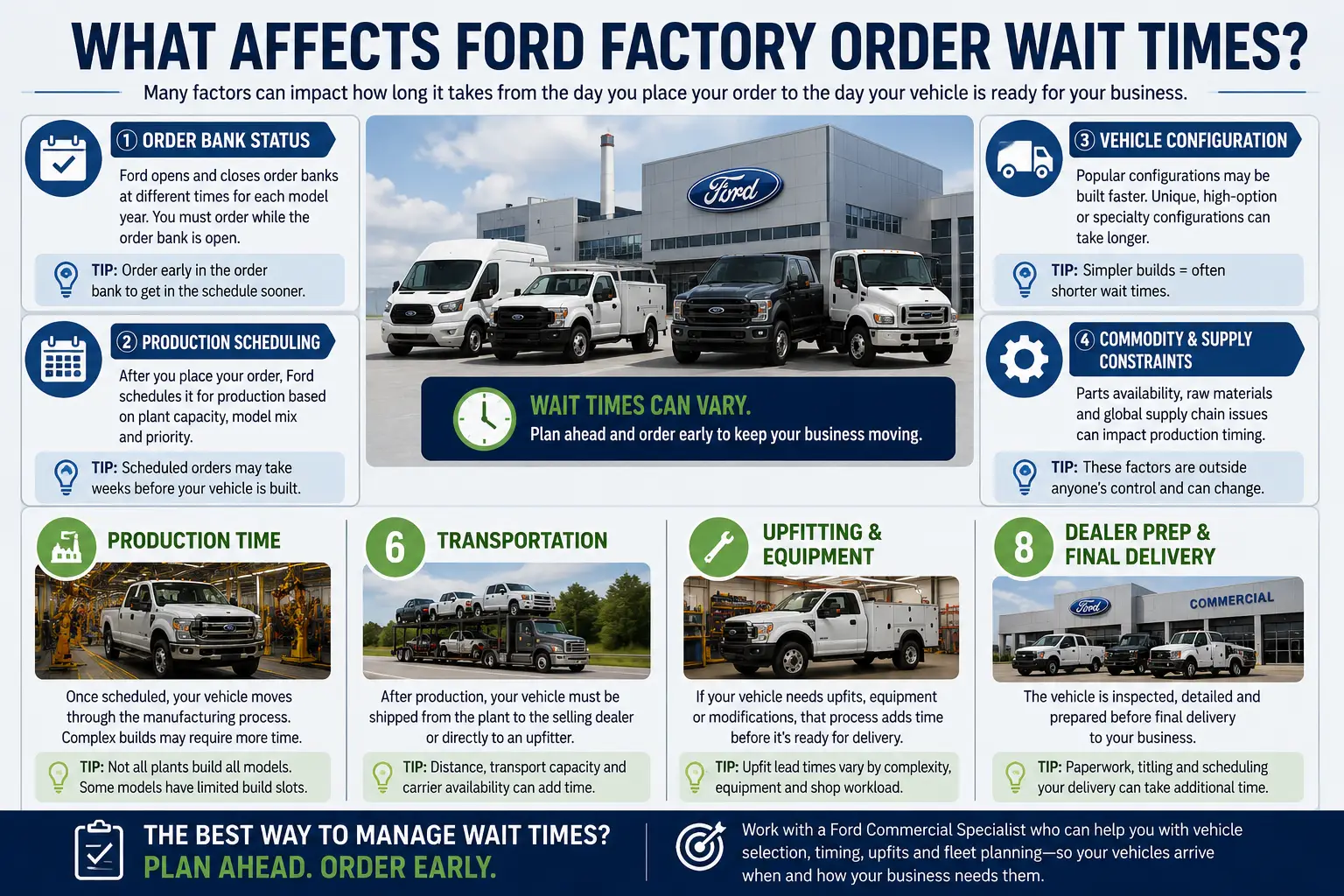
Several separate factors can influence the time between placing the order and putting the finished vehicle into service.
Order Bank Availability
Before Ford can build a factory order, the model must be available for ordering.
Ford opens and closes order banks at different times depending on the model and model year.
If a business waits until late in a model-year ordering cycle, an order bank may close before the company is ready to submit the vehicle.
The business may then need to wait for the next model-year order bank or find a vehicle already in inventory.
Why Ordering Early Matters
Businesses that know they will need vehicles in the future can begin reviewing configurations before the purchase becomes urgent.
That makes it easier to act when the appropriate order bank opens.
The Vehicle Configuration Can Affect Timing
Not every version of a Ford model is necessarily produced on the same schedule.
The engine, drivetrain, cab, body, packages and individual options selected on an order can affect how easily the vehicle fits into available production.
Commercial vehicles can be particularly configuration-sensitive because businesses frequently need specialized equipment or less common combinations.
Engine
Different engines can have different production and availability considerations.
Drivetrain
4×2, 4×4, AWD and other drivetrain configurations can affect the build.
Cab & Body
Cab, bed, wheelbase, roof height and body configurations can affect production timing.
Packages
Towing, technology and commercial packages add specific components to the build.
Individual Options
Certain individual options may affect how quickly the complete configuration can be produced.
Commercial Equipment
Specialized equipment may add additional steps after the base vehicle leaves the factory.
Commodity and Parts Availability
Building a vehicle requires thousands of individual components.
If a particular component needed for your configuration is limited, that can affect when the complete vehicle can be scheduled or built.
These types of conditions can change throughout the model year, which is another reason factory-order timelines should be treated as estimates rather than guarantees.
Availability Can Change
A configuration that is easy to schedule today could encounter different production conditions later in the year.
Likewise, a temporary constraint can sometimes improve as parts or production capacity become available.
Production Capacity and Scheduling
Ford has to balance many orders across its assembly plants and production schedules.
Plant capacity, model mix, equipment availability and other production considerations can affect when an individual order is scheduled.
For a commercial fleet, this is important because placing an order does not automatically reserve an immediate place on the assembly line.
Submitted → Scheduled → Built
These are different stages. A vehicle can be successfully ordered but still be waiting for production scheduling.
Transportation Adds Another Part of the Timeline
Finishing production does not mean the vehicle is ready for the customer the next day.
The completed vehicle still has to move from the assembly plant to its next destination.
Depending on the order, that destination might be the selling dealership, a commercial upfitter or another facility in the delivery process.
Distance, transportation capacity, routing and carrier availability can all affect this stage.
Production Complete Is Not the Same as Delivered
When planning a replacement date, businesses should allow time for transportation and final processing after the vehicle has been built.
Commercial Upfits Can Add Time After Production
Many work vehicles are not finished when they leave the Ford assembly plant.
A Transit cargo van may need shelving and ladder racks. A Super Duty may need a service body, dump body or other commercial equipment. Other businesses may require specialized storage, electrical equipment or vocational bodies.
The upfitter needs both the vehicle and the required equipment before the work can be completed.
Upfit Timing Can Depend On:
- Type of upfit
- Equipment availability
- Body manufacturer lead time
- Upfitter workload
- Vehicle transportation
- Complexity of installation
Plan the Upfit Before Ordering
When possible, determine the upfit requirements before the factory vehicle configuration is finalized.
This helps make sure the correct base vehicle is ordered and gives additional time to coordinate the equipment.
Explore Commercial Vehicle Upfits →Dealer Preparation and Final Delivery
Once the vehicle reaches the dealership, there are still final steps before it is ready to enter your fleet.
The vehicle needs to be received, inspected and prepared for delivery. Paperwork, titling, financing and delivery scheduling may also need to be completed.
For a business ordering several vehicles, delivery may also be coordinated around employee schedules, company locations or fleet deployment plans.
How Can a Business Reduce the Risk of Factory Order Delays?
You cannot control every part of the manufacturing process, but good planning can reduce avoidable delays.
Order Early
Start planning before the replacement vehicle becomes an urgent operational need.
Finalize the Correct Build
Review the vehicle configuration carefully before the order is submitted.
Plan Upfits Early
Identify required bodies, shelving and equipment before the base vehicle is ordered.
Avoid Unnecessary Complexity
Do not add options the business does not actually need simply because they are available.
Forecast Replacements
Identify vehicles likely to need replacement months before they become unreliable.
Review Order Status
Follow available production information and adjust operational plans when needed.
Businesses Should Order Before the Vehicle Becomes an Emergency
The worst time to begin a factory order is often the day an existing fleet vehicle fails and must be replaced immediately.
At that point, waiting for a factory order may no longer be practical and the business can be forced to choose from whatever inventory happens to be available.
Fleet replacement planning gives the company more time to choose the right vehicle, factory order the desired configuration and coordinate upfits and financing.
Explore Fleet Replacement PlanningWatch for Replacement Signals
- Increasing vehicle mileage
- Higher maintenance expenses
- Repeated downtime
- Changing employee requirements
- Growing workload
- Future location expansion
- New commercial equipment needs
Should You Wait for Next Year’s Ford Model?
Sometimes the bigger timing question is not how long the current vehicle will take to build, but whether the business should order the current model year or wait for the next model year.
Ford models do not all move into a new model year at exactly the same time.
Order banks, production changeovers and availability vary by vehicle line.
Businesses with future vehicle needs should therefore review model-year timing before waiting automatically for January or another calendar date.
Coming Next
Our guide to When to Order Next Year’s Ford Models for Your Business Fleet explains how businesses should think about order-bank openings and model-year transitions.
FIN Customers Can Have Access to Additional Order Information
Businesses approved for a Ford Fleet Identification Number can access applicable Ford fleet resources, including vehicle order-status and production availability information.
This can be useful for companies managing several vehicle orders or planning replacements across a larger fleet.
Explore Ford FIN Code BenefitsDon’t Have a FIN Code?
If your business operates multiple vehicles or has qualifying recent vehicle purchase activity, it may be worth reviewing whether you qualify.
Check FIN Code Eligibility →When Does Waiting for a Factory Order Make Sense?
Dealer Inventory May Be Better If:
- You need a vehicle immediately
- The correct configuration is already available
- You are flexible on certain options or colors
- The vehicle does not require specialized ordering
Factory Ordering May Be Better If:
- You have time before the vehicle is needed
- You need a specific configuration
- You need several similar vehicles
- The vehicle requires a commercial upfit
- You are planning future fleet replacements
- You want greater control over the final build
Plan Your Next Ford Factory Order
How to Factory Order a Ford
Follow the complete process from vehicle selection through configuration, ordering and delivery.
Read the Factory Order Guide →Factory Fleet Ordering
Learn how commercial businesses can order Ford vehicles around current and future fleet needs.
Explore Factory Fleet Ordering →Fleet Replacement Planning
Identify future vehicle needs before replacement becomes urgent.
Explore Replacement Planning →Commercial Vehicle Upfits
Coordinate service bodies, shelving, racks and other equipment with the base vehicle order.
Explore Commercial Upfits →Ford FIN Code Benefits
Learn about ordering resources and other benefits available to qualified Ford fleet customers.
Explore FIN Benefits →Fleet Financing
Review commercial financing and leasing options as part of the complete vehicle acquisition plan.
Explore Fleet Financing →Ford Factory Order Wait Time FAQ
How long does a Ford factory order take?
There is no single wait time for every Ford factory order. Timing depends on the model, vehicle configuration, scheduling, production conditions, parts availability, transportation and whether additional commercial equipment must be installed.
Why hasn’t my Ford order been scheduled yet?
An order can be successfully submitted before it is selected for production. Scheduling can depend on production capacity, configuration, component availability and other manufacturing considerations.
Does choosing more options make a Ford order take longer?
It can. Certain configurations or options may be affected by production scheduling or component availability. The impact can vary throughout the model year.
Does the wait time include shipping?
The complete customer timeline should include transportation after production. A vehicle may be finished at the factory but still need time to reach the dealer or commercial upfitter.
Does a commercial upfit add to the wait time?
Usually, yes. If shelving, a service body, ladder racks or other commercial equipment is installed after production, that work becomes another stage before the vehicle is ready for the business.
Can my dealer guarantee a Ford factory order delivery date?
Factory-order timing should generally be treated as an estimate because production, transportation, parts availability and other factors can change.
When should I order a Ford for my business?
Businesses should ideally begin planning before the vehicle becomes an immediate need. The appropriate timing depends on the model, order-bank status, configuration, upfit requirements and expected replacement date.
Is it faster to buy a Ford already in dealer inventory?
If the correct vehicle is already available, purchasing from inventory is generally faster than waiting for a new factory order. Factory ordering becomes more valuable when the business needs a specific configuration and has enough time to plan ahead.
Start Planning Your Ford Factory Orders Early
If your business knows it will need trucks, vans or other commercial vehicles in the future, we can review the expected replacement dates, vehicle configurations, factory-order timing and upfit requirements before those vehicles become urgent needs.
Planning ahead gives your business more opportunity to order the vehicle it actually needs instead of settling for whatever happens to be available when the time comes.