TRAC Lease vs. Buying With Cash: Which Is Better for a Business?
Paying cash for a commercial vehicle eliminates a monthly vehicle payment, but it also moves business capital into a depreciating asset. A TRAC lease takes a different approach by allowing a business to preserve more working capital while using the vehicle.
Is It Better to TRAC Lease or Pay Cash for a Business Vehicle?
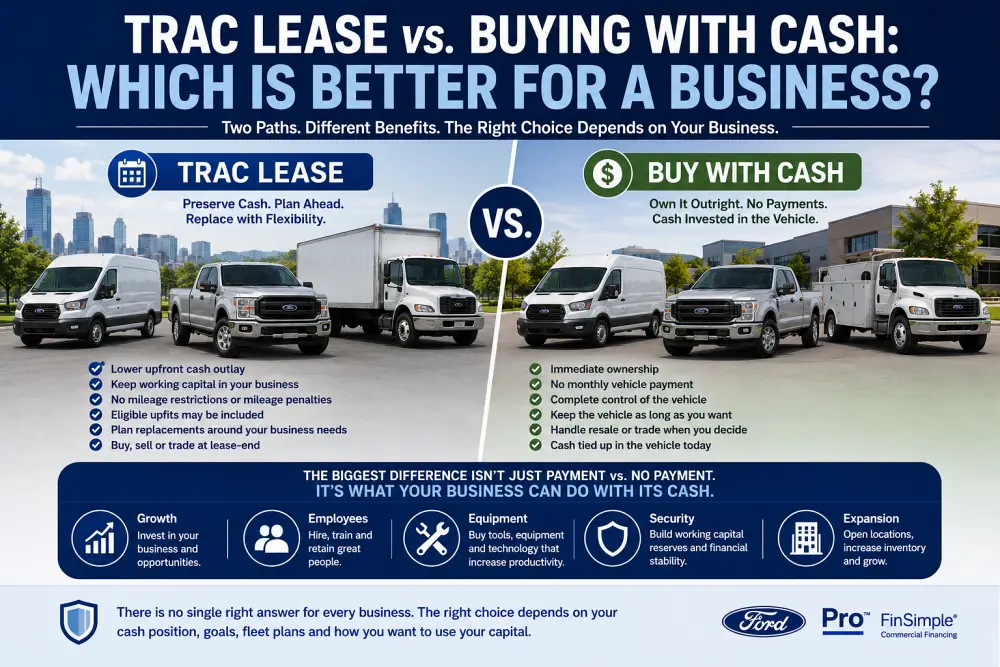
There is no single answer that is right for every business.
Paying cash may make sense for a company with substantial available capital that wants immediate ownership and expects to keep the vehicle for many years.
A TRAC lease may make more sense when preserving working capital, acquiring multiple vehicles or maintaining a planned fleet replacement cycle is important.
Cash provides immediate ownership. TRAC leasing may preserve capital and provide greater flexibility for businesses that replace vehicles regularly.
TRAC Lease vs. Cash Purchase at a Glance
Both options can work well. The right choice depends on the company’s cash position, ownership goals, replacement plans and how the vehicle will be used.
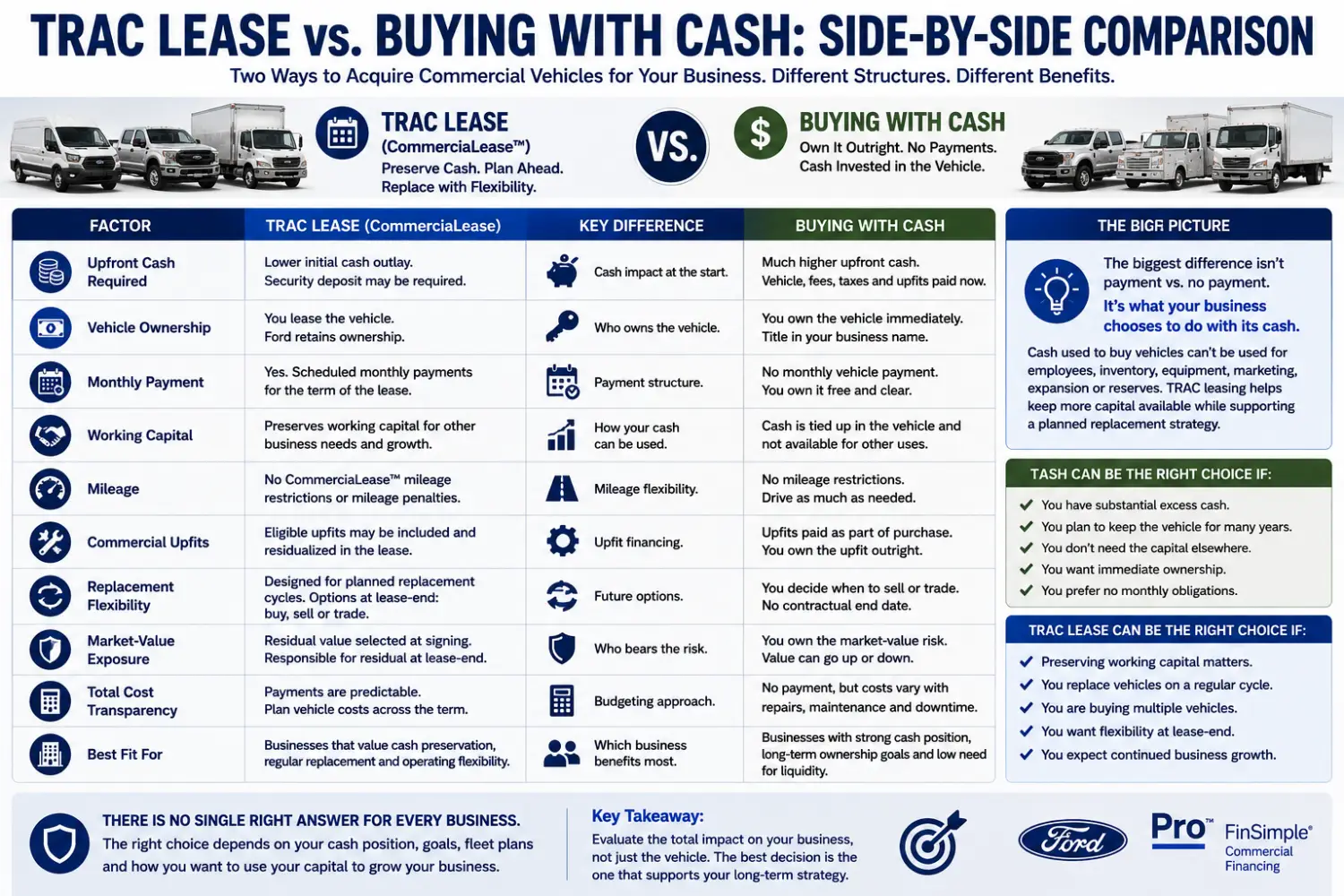
TRAC leasing and paying cash offer different advantages. The right choice depends on working capital, ownership goals, vehicle replacement plans and how the business wants to use its available cash.
What Happens When a Business Buys a Vehicle With Cash?
A cash purchase is the simplest vehicle-acquisition structure.
The business pays the purchase price and applicable taxes, fees and commercial upfit costs, and the vehicle becomes an asset of the company.
Once purchased:
- The business owns the vehicle outright
- There is no monthly vehicle loan or lease payment
- There is no lender or lease residual
- The company decides when to keep, sell or trade the vehicle
- The company carries the vehicle’s market-value risk
That can be attractive for businesses that have significant available cash and plan to keep vehicles for a long time.
The tradeoff is that the cash used to purchase the vehicle is no longer available for other business needs.
What Happens When a Business Uses a TRAC Lease?
Ford Pro FinSimple CommerciaLease is an open-ended Terminal Rental Adjustment Clause, or TRAC, lease designed for commercial vehicle use.
Instead of paying the full cost of the vehicle upfront, the business enters into a commercial lease with a selected term and residual value.
CommerciaLease features can include:
- Scheduled lease payments
- No mileage restrictions or mileage penalties
- No excess wear-and-use charges typically associated with traditional leases
- Flexible lease terms
- Eligible commercial upfits that may be included in the transaction
- Buy, sell or trade options at lease-end
What Else Could the Business Do With the Cash?
This is where the TRAC lease vs. cash decision becomes more important.
A business may have enough cash to buy a vehicle, but that does not automatically mean purchasing it outright is the best financial decision.
Money used to purchase vehicles cannot simultaneously be used for other business needs such as:
- Hiring employees
- Payroll
- Inventory
- Tools and equipment
- Advertising
- Opening another location
- Purchasing materials
- Building cash reserves
- Funding business growth
The biggest difference is not simply payment vs. no payment. It is what your business can do with the cash that would otherwise be tied up in vehicles.
The Opportunity Cost of Paying Cash for Vehicles
Business owners often compare a cash purchase to financing by looking only at interest or monthly payments.
But there is another cost to consider: opportunity cost.
Opportunity cost is simply the value of what the business could have done with the money if it had not been used to purchase the vehicle.
Simple Business Example
A growing contractor may have enough cash to purchase several work trucks.
But that same capital might also be needed to hire technicians, purchase equipment, fund inventory or support expansion.
In that situation, preserving some of the company’s cash may be more valuable than eliminating the vehicle payment.
A Contractor Needs Several New Commercial Vehicles
Imagine a growing contractor needs:
- Several Transit service vans
- F-150 supervisor trucks
- A Super Duty with a commercial service body
The company could purchase all of the vehicles with cash.
That would eliminate monthly vehicle payments, but it would also move a significant amount of working capital into vehicles immediately.
Another option would be to use commercial financing or CommerciaLease TRAC for some or all of the vehicles.
That could leave more capital available for the company’s other operating and growth needs.
The important question becomes: Does eliminating the vehicle payment create more value than keeping the capital available to the business?
When Buying a Commercial Vehicle With Cash Can Make Sense
Paying cash can be a strong choice for the right business.
It may make sense when:
- The company has substantial excess cash
- Purchasing the vehicle will not reduce needed working capital
- The vehicle will remain in service for many years
- The company wants immediate ownership
- The business does not want monthly financing obligations
- The company prefers to manage resale or trade timing itself
- The vehicle has a long expected service life
A business with strong liquidity should not lease simply because leasing is available.
When a TRAC Lease Can Make More Sense
TRAC leasing may be worth considering when the company values flexibility and working-capital preservation.
It may be a better fit when:
- Preserving cash is important
- The business is growing
- Several vehicles are being acquired
- Vehicles are replaced on a regular cycle
- Commercial upfits are involved
- The company wants predictable scheduled vehicle payments
- The fleet is being actively managed and replaced
- The business expects additional vehicle needs during the year
No Vehicle Payment Does Not Mean No Vehicle Cost
One common mistake is treating a vehicle as essentially free after it has been purchased with cash.
The business may no longer have a monthly vehicle payment, but the vehicle still creates costs.
Those costs can include:
- Depreciation
- Maintenance
- Repairs
- Tires
- Insurance
- Registration
- Fuel
- Downtime
- Opportunity cost of the money invested in the vehicle
No payment does not mean no cost.
A TRAC Lease Is Not Automatically the Lower-Cost Option
The opposite mistake is assuming that TRAC leasing is automatically less expensive because it can require less upfront cash.
A TRAC lease still includes financing costs and residual responsibility.
A business should not choose a lease simply because the scheduled payment looks attractive.
The residual value, lease term, approved rate, vehicle value and expected replacement strategy all matter.
What About Commercial Vehicle Upfits?
Commercial vehicles often require much more than the chassis itself.
A work vehicle may also need:
- Service body
- Utility body
- Van shelving
- Partition or bulkhead
- Ladder rack
- Storage systems
- Specialized vocational equipment
When purchasing with cash, the business generally pays for the vehicle and upfit as part of its total investment.
With Ford Pro FinSimple CommerciaLease, eligible commercial upfits may be included in the lease structure and may be residualized according to applicable program requirements.
Cash vs. TRAC Lease for One Commercial Vehicle
The answer can be very different for a business purchasing only one vehicle.
A well-capitalized contractor purchasing one work truck that it expects to keep for many years may decide that paying cash is simple and practical.
If purchasing that vehicle will not affect payroll, reserves or growth plans, immediate ownership may be attractive.
TRAC leasing can still be considered, but preserving working capital may be less important when the purchase represents only a small portion of the company’s available liquidity.
Cash vs. TRAC Lease for a Commercial Fleet
The conversation changes as the fleet becomes larger.
A business replacing several vehicles every year must consider more than the cost of one truck or van.
Fleet-level considerations include:
- Annual capital requirements
- Factory ordering schedules
- Commercial upfits
- Replacement timing
- Trade values
- Maintenance costs
- Vehicle downtime
- Employee growth
- Future vehicle demand
This is where a planned financing and replacement strategy can become more valuable than making each vehicle decision separately.
Consider a Business Operating 25 Vehicles
A 25-vehicle fleet usually should not wait until all 25 vehicles need replacement at the same time.
A more organized approach is to evaluate the fleet regularly and replace vehicles in planned groups.
That process can repeat throughout the year.
Instead of making very large periodic cash purchases, the company can consider aligning financing or leasing with its replacement schedule.
Where Ford Commercial Line of Credit Fits
Businesses that expect to acquire multiple vehicles throughout the year may also want to consider Ford Commercial Line of Credit, commonly called CLOC.
For qualified businesses, CLOC can establish commercial credit that may be used for eligible Ford Pro FinSimple financing and leasing transactions.
That can help a company plan vehicle acquisitions without treating every vehicle as a completely separate financing event.
The choice does not always have to be cash everything or lease everything.
Does Every Vehicle in a Fleet Need the Same Financing Strategy?
No.
Different vehicles can have different jobs, replacement cycles and expected service lives.
Example of a Mixed Fleet Strategy
A business might pay cash for a specialized truck it plans to operate for many years.
It might use traditional commercial financing for another vehicle it wants to own long-term.
The same business might use CommerciaLease TRAC for service vans it intends to replace regularly.
Financing should fit the job of the vehicle and the financial strategy of the business.
What About Taxes?
Tax treatment can be an important part of the cash-vs.-lease decision, but it should be reviewed with the company’s accountant or tax professional.
Vehicle purchases, depreciation, lease payments and business-use deductions can be treated differently depending on the company, vehicle, transaction and current tax law.
Do not choose a vehicle-financing structure based solely on an assumed tax benefit. Review the actual transaction with a qualified tax professional.
Questions to Ask Before Paying Cash for a Commercial Vehicle
- How much cash will remain after the purchase?
- Does the company need that money for payroll or growth?
- How long will the vehicle stay in the fleet?
- How much will the commercial upfit cost?
- Are additional vehicles due for replacement soon?
- Is the company hiring or expanding?
- Could the capital earn a better return elsewhere in the business?
- Is immediate ownership important?
- Can the business comfortably absorb future repair costs?
Questions to Ask Before Choosing a TRAC Lease
- How long do we plan to operate the vehicle?
- How much mileage will it accumulate?
- What residual value makes sense?
- Will we likely buy, sell or trade the vehicle at lease-end?
- Does the commercial upfit qualify?
- What is our replacement cycle?
- What approved rate and lease terms are available?
- What happens if market value is below the selected residual?
- Does preserving capital create meaningful value for the business?
TRAC Lease vs. Cash: Which Is Better?
Cash May Be Better When:
The company has strong liquidity, wants immediate ownership, expects to keep the vehicle for many years and does not need the cash elsewhere in the business.
TRAC Leasing May Be Better When:
Preserving working capital is important, the business acquires vehicles regularly, commercial upfits are involved or the fleet follows a planned replacement cycle.
The right answer depends less on whether your company can afford to pay cash and more on whether paying cash is the best use of the company’s capital.
Learn More About TRAC Leasing and Fleet Financing
Explore the rest of the commercial financing series to better understand TRAC leasing, fleet credit, upfits, payments and vehicle replacement.
TRAC Lease vs. Cash Purchase FAQs
Is it better for a business to lease or pay cash for a vehicle?
It depends on the company’s cash position, vehicle replacement strategy and ownership goals. Paying cash provides immediate ownership, while a TRAC lease may help preserve working capital and support a planned replacement cycle.
Is a TRAC lease cheaper than buying a vehicle with cash?
Not automatically. Paying cash eliminates financing charges, while a TRAC lease allows the business to preserve more capital. Businesses should compare total vehicle cost, financing costs, residual responsibility and the value of keeping cash available for other uses.
Why would a profitable business lease vehicles instead of paying cash?
A profitable company may still prefer to keep cash available for payroll, growth, inventory, equipment, reserves or other investments. Leasing can allow the business to acquire needed vehicles without committing the full vehicle cost upfront.
Does buying a business vehicle with cash eliminate vehicle costs?
No. The company may eliminate a monthly loan or lease payment, but the vehicle still creates depreciation, maintenance, repair, insurance, fuel, registration and downtime costs.
Can commercial upfits be included in a TRAC lease?
Ford Pro FinSimple states that eligible commercial upfits may be included in a CommerciaLease transaction and may be residualized subject to applicable program requirements.
Does a Ford CommerciaLease TRAC lease have mileage limits?
Ford currently states that CommerciaLease has no mileage restrictions or mileage penalties typically associated with traditional closed-end leases.
Can I buy a vehicle at the end of a TRAC lease?
Ford’s CommerciaLease lease-end options can include buying, selling or trading the commercial vehicle according to the lease terms. The lessee remains responsible for the selected residual value.
Can a company use both cash purchases and TRAC leases?
Yes. Different vehicles may require different financial strategies. A business may purchase some long-term vehicles with cash while leasing vehicles that are replaced more frequently.
Not Sure Whether to Lease, Finance or Pay Cash?
There is no reason to make the decision based only on a monthly payment.
We can review your current vehicles, replacement schedule, expected mileage, commercial upfits, growth plans and future fleet needs.
From there, we can compare cash purchases, commercial financing, Ford Pro FinSimple CommerciaLease TRAC and available commercial credit options.
The goal is to find the structure that makes the most sense for your business, not simply the one with the lowest payment.
Important: This article is provided for general educational and fleet-planning purposes only. Financing, leasing, credit approval, lease terms, residual values, rates and program eligibility are subject to current Ford Pro FinSimple requirements and customer credit approval. Tax and accounting treatment can vary by customer and transaction. Consult your accountant, tax professional and applicable financing documents before making a financial decision.