What Is a TRAC Lease? A Guide for Business Owners
A TRAC lease is a commercial vehicle leasing option that can give businesses more flexibility when acquiring, operating and replacing work trucks and vans.

How Does a TRAC Lease Work?
For businesses that rely on trucks and vans every day, buying and financing every vehicle is not the only option. A TRAC lease provides another way to acquire commercial vehicles while giving a business flexibility in how it plans payments, residual values and future vehicle replacement.
Instead of approaching the vehicle like a traditional loan where the goal is generally to pay down the financed balance over the selected term, a TRAC lease establishes a residual value for the vehicle at the end of the lease.
That residual becomes part of the lease structure and helps determine how much of the vehicle’s cost is accounted for during the lease term.
For companies that operate several vehicles, replace trucks and vans regularly, accumulate significant mileage or require commercial upfits, a TRAC lease can be worth considering as part of a larger fleet strategy.
A Simple Example
Suppose a business needs a $70,000 commercial truck.
With traditional financing, the business would generally finance the vehicle and make payments toward the financed balance over the selected loan term.
With a TRAC lease, a residual value is established for the vehicle at lease-end. Instead of structuring the lease as though the vehicle will have no remaining value at the end of the term, that expected value becomes part of the lease structure.
Several factors can affect a TRAC lease payment, including:
- Vehicle cost
- Lease term
- Residual value
- Applicable lease rate or charges
- Vehicle configuration
- Commercial upfits
- Credit approval
- Current Ford Pro FinSimple program requirements
The goal should not simply be to create the lowest possible monthly payment. A good TRAC lease structure should consider how the business plans to use the vehicle, how long it expects to keep it and how the vehicle fits into its replacement strategy.
TRAC Leasing as a Vehicle Replacement Cycle
One of the easiest ways to understand a TRAC lease is to look at it as part of the complete life cycle of a commercial vehicle.
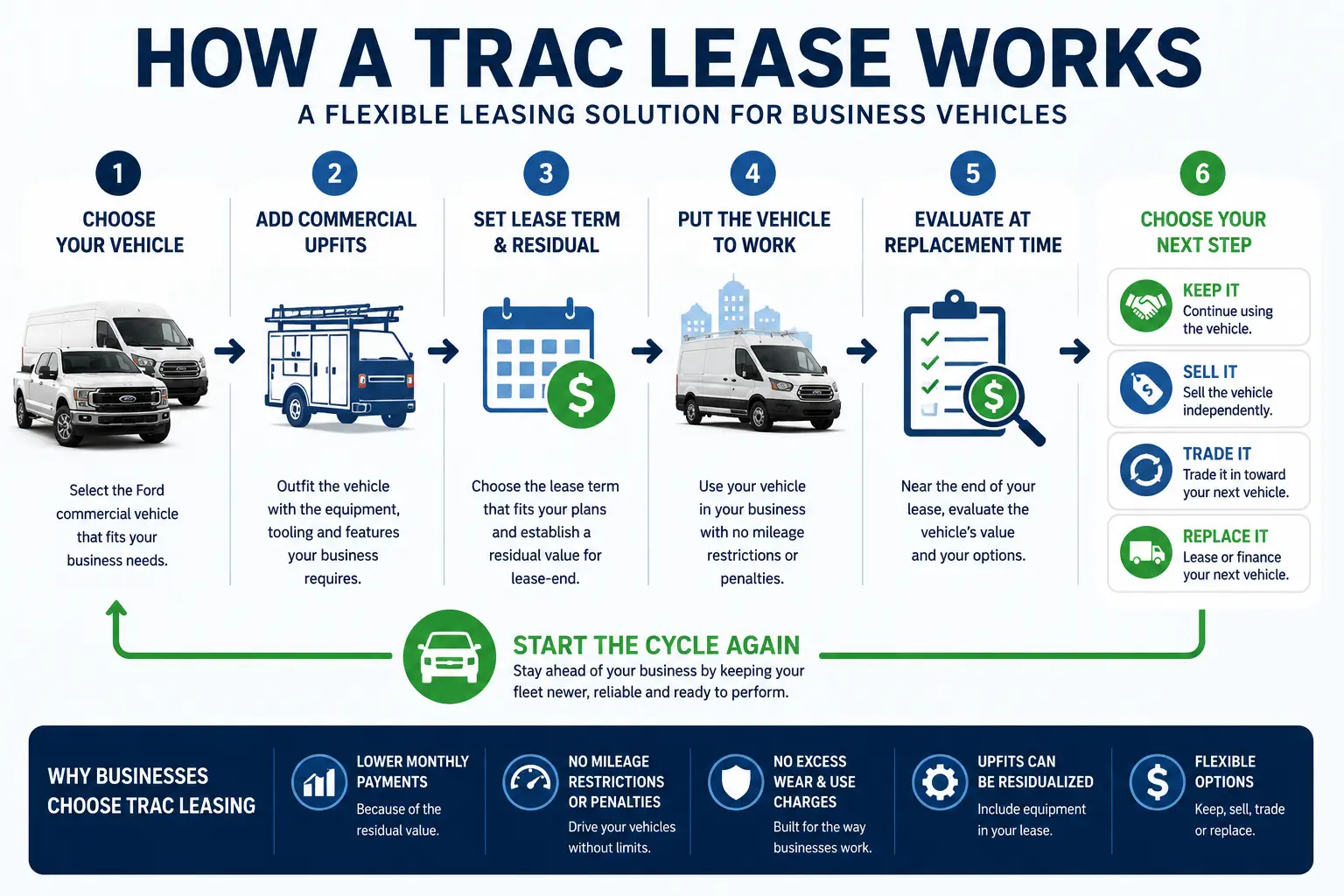
A TRAC lease can be incorporated into a planned commercial vehicle acquisition and replacement cycle.
What Is the Residual Value on a TRAC Lease?
The residual value is one of the most important concepts to understand before entering into a TRAC lease.
In simple terms, the residual is the value assigned to the vehicle at the end of the lease term.
Generally, leaving a larger residual means less of the vehicle’s value is accounted for through scheduled lease payments. That can result in a lower monthly payment.
However, a larger residual also leaves a larger amount at the end of the lease.
Under a standard Ford CommerciaLease TRAC structure, the business has responsibility related to the vehicle’s value at lease-end. This is why the residual should not simply be used as a way to chase the lowest possible monthly payment.
It should make sense for the vehicle, its expected use, lease term, mileage, equipment and the business’s replacement strategy.
Why Would a Business Consider a TRAC Lease?
Commercial vehicles can represent a significant investment for a business.
A plumbing company may operate several service trucks. An HVAC company may have a fleet of Transit vans. A contractor could operate pickups, service bodies and larger chassis cabs that all perform different jobs.
TRAC leasing gives businesses another way to structure those vehicle costs instead of automatically financing the full purchase of every unit.
A TRAC lease may be worth considering for businesses that:
- Operate multiple commercial vehicles
- Accumulate substantial annual mileage
- Replace vehicles on a planned schedule
- Need specialized commercial upfits
- Want flexibility when structuring vehicle costs
- Expect their fleet to grow
- Want to preserve working capital for other business needs
No Mileage Restrictions or Mileage Penalties
One of the major differences between Ford CommerciaLease and the traditional vehicle lease many consumers are familiar with is mileage.
Ford states that CommerciaLease has no mileage restrictions or mileage penalties.
That can be particularly useful for businesses because commercial mileage is not always predictable.
A service van may travel 30,000 miles one year and significantly more the next. A contractor may travel between an office, suppliers and multiple jobsites throughout the day.
TRAC leasing is designed around commercial vehicle use rather than a traditional consumer driving pattern.
No Traditional Excess Wear-and-Use Charges
Ford also states that CommerciaLease does not have the traditional excess wear-and-use charges associated with many closed-end leases.
This distinction matters for a work vehicle.
Commercial trucks and vans carry tools, materials and equipment. They visit jobsites. Employees may enter and exit them dozens of times each day.
Vehicle condition still matters because it can affect the vehicle’s actual market value, but the TRAC structure is fundamentally different from a traditional closed-end retail lease.
Can a TRAC Lease Include Commercial Vehicle Upfits?
This is one area where TRAC leasing becomes especially useful for many commercial vehicle customers.
The cost of the truck or van itself may only represent part of the completed work vehicle.
A Ford Transit might need:
- Commercial shelving
- Interior partitions
- Ladder racks
- Tool storage
- Refrigeration equipment
A chassis cab could receive a:
- Service body
- Dump body
- Landscape body
- Flatbed
- Utility body
- Other specialized vocational equipment
These upfits can add thousands or even tens of thousands of dollars to the completed commercial vehicle.
Ford CommerciaLease allows commercial upfits to be included in the vehicle’s total value, and Ford states that upfits can be residualized under the program.
Because equipment can also affect the future value of a commercial vehicle, the upfit should be considered carefully when structuring the lease.
What Happens at the End of a TRAC Lease?
This is another important difference between a TRAC lease and a traditional closed-end lease.
With a standard TRAC structure, the business has responsibility related to the vehicle’s value compared with the remaining lease obligation.
If the vehicle is worth less than the applicable amount owed at lease-end, the business may be responsible for the difference.
That is important to understand before entering into the lease.
However, businesses that replace vehicles regularly do not necessarily need to wait until the last day of the lease before deciding what happens next.
Trading the Vehicle Into the Next Commercial Vehicle
One practical option is to have the current commercial vehicle appraised by the dealership when the business is preparing to acquire its replacement.
The dealer can evaluate the vehicle’s current market value along with the applicable lease obligation so the business can understand its position before deciding what to do next.
For businesses following a regular replacement cycle, the dealership may gain a desirable used commercial truck or van that can be reconditioned and offered for sale, while the business moves into a newer vehicle.
This is especially useful when replacement is planned ahead rather than waiting until an aging truck becomes unreliable and a replacement is suddenly needed.
Your Commercial Vehicles Represent Your Business
There is another reason businesses may choose to replace vehicles regularly that has little to do with the financing itself.
Your customers see them.
A plumbing van, HVAC truck, electrician’s service vehicle or contractor’s pickup may have the company’s logo, phone number and branding displayed across it.
In many ways, that vehicle is a moving billboard for the company.
Keeping a clean, professional-looking fleet can help maintain the image a business wants to present to customers.
Newer vehicles can also provide access to newer safety features, productivity technology and connectivity while potentially reducing some of the downtime and maintenance concerns associated with aging fleet vehicles.
That does not mean every vehicle should automatically be replaced at the end of a lease.
The better approach is to evaluate each unit and determine whether it makes sense to keep it, sell it, trade it or replace it.
TRAC Leasing and Fleet Replacement Planning
This is where TRAC leasing becomes more than simply another way to calculate a monthly payment.
Imagine a business operates 20 vehicles.
Some vehicles may only be one year old. Others may be approaching replacement. Several could have high mileage, while the company may also expect to add vehicles as the business grows.
Instead of waiting until a vehicle breaks down or becomes too expensive to maintain, the company can establish a replacement schedule.
Evaluate the fleet → Identify future replacements → Order vehicles ahead of time → Determine financing or lease structure → Complete upfits → Trade outgoing vehicles → Put replacements into service
Now vehicle acquisition becomes planned instead of reactive.
For businesses operating several vehicles, planning can also reduce the chance of suddenly needing to replace several expensive units at the same time.
TRAC Lease vs. Financing
A TRAC lease is not automatically better than traditional commercial financing.
There are situations where purchasing and financing a commercial vehicle may make more sense.
A company planning to operate a truck for a very long time may approach the decision differently than a company that wants to replace vehicles on a predictable cycle.
Important considerations include:
- Expected ownership period
- Cash flow
- Annual mileage
- Vehicle use
- Upfit investment
- Replacement schedule
- Business credit
- Expected future vehicle value
- Tax and accounting considerations
This is why comparing only monthly payments does not tell the complete story.
Businesses should consult a qualified tax or accounting professional regarding the tax and accounting treatment of a particular lease or vehicle purchase.
Where Does a Ford Commercial Line of Credit Fit?
If a business is acquiring one vehicle, financing may be approached as an individual transaction.
But consider a business operating 30 vehicles.
It may replace several trucks this year, add vans because the company is growing and place additional factory orders for the following year.
Treating every vehicle as an entirely separate credit event can become inefficient.
A Ford Commercial Line of Credit (CLOC) can provide qualified businesses with a pre-established amount of credit for commercial vehicle purchases and leases, subject to Ford Credit approval, eligibility and current program requirements.
Ford indicates that CLOC can be used with eligible commercial financing products, including CommerciaLease (TRAC).
For companies acquiring multiple vehicles throughout the year, a commercial line of credit can work naturally alongside fleet planning, factory ordering, TRAC leasing and traditional commercial financing.
Is a TRAC Lease Right for Your Business?
There is not one financing structure that is right for every business or every commercial vehicle.
Some companies may be better served by traditional commercial financing. Others may benefit from TRAC leasing.
A business may even choose to finance certain vehicles while TRAC leasing others.
The better starting point is understanding how the business actually uses its fleet:
- How many vehicles do you currently operate?
- How many miles do they travel each year?
- How long do you normally keep them?
- Which vehicles are approaching replacement?
- Are you adding vehicles as the company grows?
- What type of upfits do your vehicles require?
- How are your vehicles currently financed?
- How important is monthly cash flow?
- What do you expect your fleet to look like three to five years from now?
Once those questions are answered, it becomes much easier to compare the available options and build a vehicle acquisition strategy around the business.
Continue Learning About Commercial TRAC Leasing
This guide is the starting point. Explore individual TRAC lease topics in greater detail as we build the complete commercial vehicle leasing resource center.
Estimate a TRAC Lease Payment
Want to see how vehicle price, term, residual value and rate assumptions can affect an estimated TRAC lease payment?
Use our TRAC Lease Calculator as a planning tool and compare different scenarios before discussing an actual lease structure.
TRAC Lease FAQs
What does TRAC stand for?
TRAC stands for Terminal Rental Adjustment Clause. It is a type of open-ended lease commonly used for commercial vehicles.
What is Ford’s TRAC lease called?
Ford Credit offers its TRAC lease through Ford Pro FinSimple under the CommerciaLease program.
Does a Ford TRAC lease have mileage limits?
Ford states that CommerciaLease has no mileage restrictions or mileage penalties, making it useful for businesses whose annual mileage can vary.
Can commercial vehicle upfits be included in a TRAC lease?
Ford states that commercial upfits can be included in the vehicle’s total value and can be residualized under CommerciaLease, subject to current program requirements and approval.
Can I trade a vehicle that is currently on a TRAC lease?
A business can have the vehicle appraised by a dealership when planning its replacement. The dealer can compare the vehicle’s current market value with the applicable lease obligation so the business can evaluate whether trading the vehicle into its next commercial vehicle makes sense.
Is a TRAC lease better than financing?
Not necessarily. The better option depends on the business’s cash flow, vehicle use, replacement cycle, mileage, upfits, expected ownership period and other factors.
Can a Ford Commercial Line of Credit be used with a TRAC lease?
Ford indicates that qualified businesses can use an approved Commercial Line of Credit with eligible commercial products including CommerciaLease, subject to Ford Credit requirements.
Not Sure Whether to Lease or Finance Your Next Commercial Vehicle?
A commercial vehicle decision involves more than choosing a truck and calculating a payment.
Vehicle selection, factory ordering, upfits, commercial financing, TRAC leasing, commercial credit and replacement timing can all affect the long-term cost of operating your fleet.
I offer businesses a no-cost fleet needs evaluation where we can review your current vehicles, upcoming replacements, future growth and the commercial vehicle options that may fit your business.
The goal is not simply to put another truck in your fleet. It is to help develop a vehicle plan that makes sense for your business today and where your fleet is going next.
How Does Ford CommerciaLease Compare With a Fleet Company Lease?
Once you understand the TRAC adjustment, compare the same finished Ford vehicle, term, mileage and upfit under each proposal. Include management fees, maintenance, residual exposure and end-of-term responsibilities.
Read the Ford TRAC versus fleet company lease comparison and see the wider Ford Pro fleet guide.