TRAC Lease vs. Red Carpet Lease: What’s the Difference?
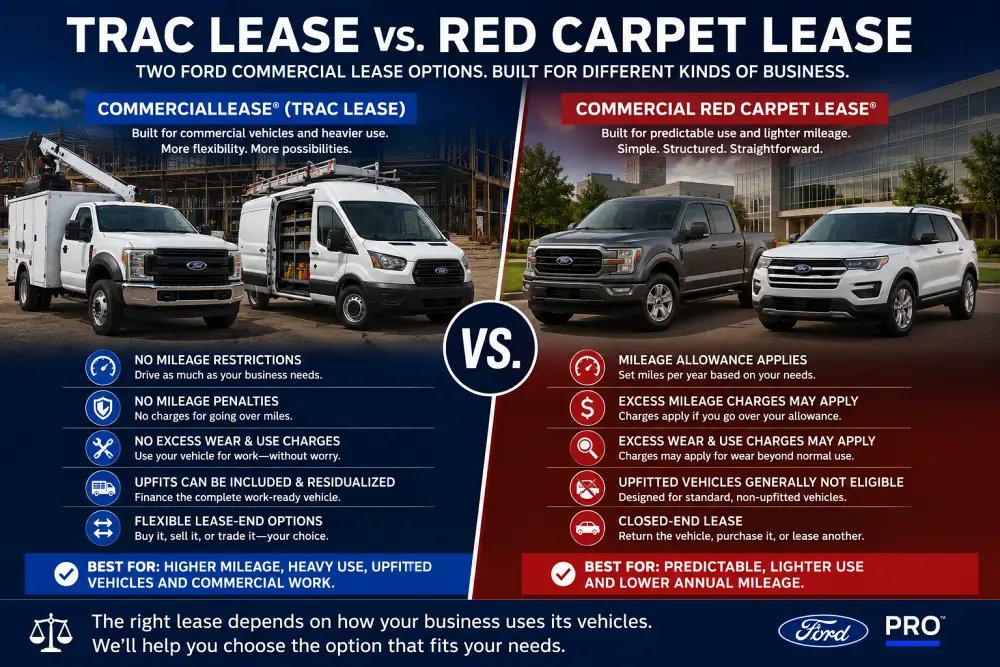
Ford CommerciaLease TRAC and Red Carpet Lease are both ways to lease a Ford vehicle, but they are designed for very different types of use.
Two Different Ways to Lease a Ford Business Vehicle
When a business wants to lease a Ford vehicle, two different lease structures may come into the conversation:
- Ford CommerciaLease — TRAC Lease
- Red Carpet Lease
If you are reviewing Ford Pro FinSimple commercial financing information, you may also see the second option referred to as Commercial Red Carpet Lease.
The terminology can make the programs sound more similar than they actually are.
CommerciaLease is an open-ended Terminal Rental Adjustment Clause lease designed specifically around commercial vehicle use.
Red Carpet Lease is a more traditional closed-end lease with an agreed mileage allowance and vehicle-condition requirements.
A TRAC lease is generally built for businesses that need more flexibility in how a work vehicle is used. Red Carpet Lease is generally better suited to predictable mileage and lighter vehicle use.
TRAC Lease vs. Red Carpet Lease at a Glance
The biggest differences involve mileage, commercial use, upfits, residual responsibility and what happens when the lease ends.
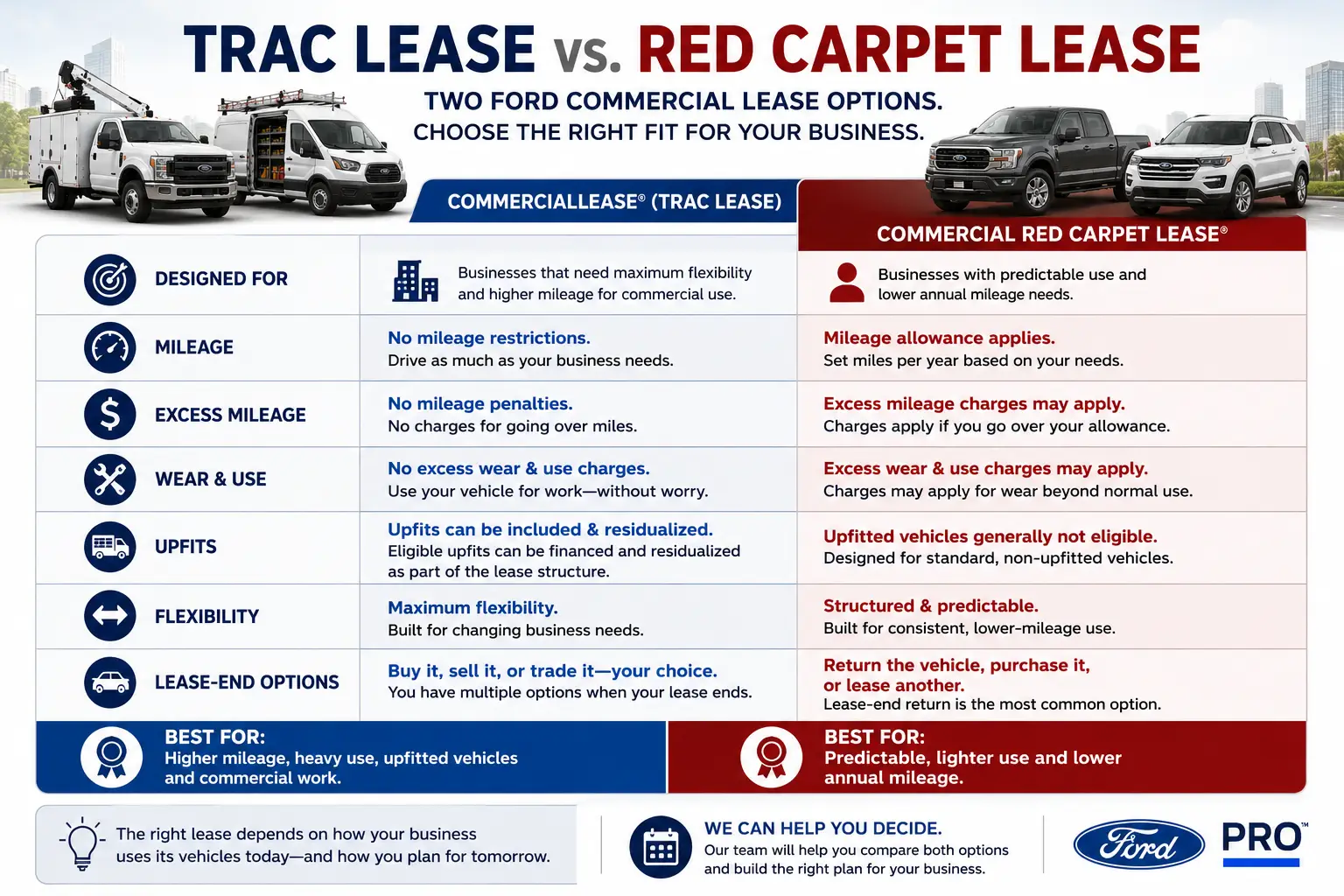
Ford CommerciaLease TRAC and Red Carpet Lease are designed for different types of business vehicle use.
Quick Comparison: TRAC Lease vs. Red Carpet Lease
| Feature | CommerciaLease TRAC | Red Carpet Lease |
|---|---|---|
| Lease Structure | Open-ended TRAC lease | Closed-end lease |
| Mileage | No mileage restrictions or mileage penalties | Agreed mileage allowance |
| Excess Mileage | No mileage penalty | Excess mileage charges may apply |
| Wear & Use | No traditional excess wear-and-use charges | Excess wear-and-use charges may apply |
| Commercial Upfits | Eligible upfits can be included and residualized | Better suited to standard, non-upfitted vehicles |
| Residual Responsibility | Business has responsibility related to lease-end value | Closed-end structure limits the customer’s residual-value exposure when lease terms are satisfied |
| Best Fit | Higher mileage, work vehicles and heavier commercial use | Predictable mileage and lighter use |
What Is Ford CommerciaLease TRAC?
Ford CommerciaLease is an open-ended Terminal Rental Adjustment Clause lease, commonly called a TRAC lease.
It is designed around the realities of operating commercial vehicles.
Ford CommerciaLease provides features such as:
- No mileage restrictions
- No mileage penalties
- No traditional excess wear-and-use charges
- Flexible residual structures
- Ability to include eligible commercial upfits
- Ability to residualize qualifying upfits
- Flexible lease-end options
Those features can make CommerciaLease particularly useful for work trucks, service vans and other vehicles that accumulate substantial mileage or require commercial equipment.
What Is Ford Red Carpet Lease?
Red Carpet Lease is Ford Credit’s traditional closed-end vehicle lease.
It is closer to the type of lease many consumers already understand.
The customer agrees to a lease term, mileage allowance and vehicle-use requirements.
At lease-end, the customer may generally have options such as returning the vehicle, purchasing the vehicle or replacing it with another vehicle according to the applicable lease terms.
For business customers, Ford Pro FinSimple materials may refer to this option as Commercial Red Carpet Lease.
Regardless of which name you see, the important distinction for this comparison is that Red Carpet Lease uses a closed-end lease structure.
The customer needs to consider items such as:
- Agreed annual mileage
- Excess mileage charges
- Vehicle condition
- Excess wear and use
- Lease-end return requirements
Red Carpet Lease can work very well for a business vehicle when mileage and use are predictable.
Open-End TRAC Lease vs. Closed-End Red Carpet Lease
CommerciaLease TRAC
CommerciaLease is an open-ended lease.
A residual value is established as part of the lease, and the business has responsibility related to the value of the vehicle at lease-end.
This can provide substantial flexibility, but it also means residual planning matters.
Red Carpet Lease
Red Carpet Lease is a closed-end lease.
When the customer satisfies the terms of the lease, the customer generally does not have the same responsibility for changes in the vehicle’s market value.
Instead, mileage and vehicle condition become more important.
TRAC leasing provides more flexibility around commercial use, while Red Carpet Lease provides a more structured closed-end lease experience.
Mileage
Mileage may be one of the easiest ways to determine which lease deserves closer consideration.
CommerciaLease TRAC Mileage
Ford states that CommerciaLease has no mileage restrictions or mileage penalties.
This can be very useful for commercial vehicles because business mileage is not always predictable.
Examples include:
- HVAC companies
- Plumbing companies
- Electrical contractors
- Construction businesses
- Delivery fleets
- Service companies
- Sales organizations
- Regional commercial fleets
A technician may drive 25,000 miles one year and 40,000 the next.
A business may gain a large new account, expand into another area or add new service routes.
The vehicle needs to be able to follow the needs of the business.
Red Carpet Lease Mileage
Red Carpet Lease uses an agreed mileage allowance.
If the vehicle exceeds the mileage allowance, excess mileage charges may apply.
That can work well when annual mileage is relatively easy to predict.
Simple Example
A company manager who consistently drives around 10,000 miles per year may fit a Red Carpet Lease much better than a field-service technician whose annual mileage can exceed 30,000 or 40,000 miles.
Wear and Use
Commercial work vehicles experience a different type of use than most personal vehicles.
A contractor’s pickup may visit construction sites every day. A service van may carry hundreds of pounds of tools, parts and equipment.
CommerciaLease TRAC
Ford states that CommerciaLease does not have the traditional excess wear-and-use charges associated with many closed-end leases.
Vehicle condition still matters because it affects the market value of the vehicle when it is eventually sold or traded.
But the business is not dealing with the same traditional closed-end lease return structure.
Red Carpet Lease
Red Carpet Lease includes vehicle-condition standards.
Excess wear and use beyond the applicable lease terms can result in additional charges when the vehicle is returned.
A work truck operating on jobsites every day may need a very different lease structure than a company vehicle used mainly for office and customer travel.
Commercial Vehicle Upfits
Upfits can quickly make TRAC leasing the more relevant option for many contractors and service businesses.
Commercial upfits can include:
- Van shelving
- Bulkhead partitions
- Ladder racks
- Tool storage
- Service bodies
- Utility bodies
- Dump bodies
- Flatbeds
- Refrigeration equipment
- Other vocational equipment
CommerciaLease TRAC
Ford CommerciaLease allows eligible commercial upfits to be included in the vehicle’s total value and residualized as part of the lease structure.
Red Carpet Lease
Red Carpet Lease is generally a much better match for standard vehicles that are not significantly modified for commercial work.
If a business needs a service body, heavily equipped Transit, dump body or other vocational vehicle, CommerciaLease is generally the Ford lease structure worth evaluating first.
Residual Responsibility
Residual responsibility is one of the most important differences between the two lease structures.
CommerciaLease TRAC
Under a standard TRAC structure, the business has responsibility related to the vehicle’s residual value.
A realistic residual should consider:
- Vehicle type
- Expected mileage
- Vehicle use
- Commercial upfits
- Lease term
- Expected condition
- Replacement timing
- Expected future market value
A higher residual may reduce scheduled monthly payments, but it also leaves a larger amount at lease-end.
Red Carpet Lease
Red Carpet Lease uses a closed-end structure.
When the customer meets the applicable lease requirements, changes in the vehicle’s market value are generally not handled in the same way they are under an open-ended TRAC lease.
Instead, mileage, vehicle condition and other lease-return requirements become more important.
What Happens at Lease-End?
CommerciaLease TRAC Lease-End
TRAC leasing can give the business several ways to deal with the vehicle when replacement time arrives.
Depending on the situation, the business may potentially:
- Keep or purchase the vehicle
- Sell the vehicle
- Trade the vehicle
- Replace it with another commercial vehicle
For businesses regularly replacing work vehicles, trading can fit naturally into a fleet replacement cycle.
Red Carpet Lease-End
At the end of a Red Carpet Lease, the customer may generally return the vehicle, purchase the vehicle or move into another vehicle according to the applicable lease terms.
This is much closer to the traditional lease experience most consumers recognize.
HVAC Service Van
Consider an HVAC company acquiring a Ford Transit service van.
The van will:
- Travel 30,000 or more miles each year
- Carry tools and replacement parts
- Have shelving installed
- Use a bulkhead partition
- Carry ladders
- Visit customer locations every day
- Eventually be replaced on a planned schedule
This is the type of vehicle where CommerciaLease may be much more practical to evaluate than Red Carpet Lease.
Mileage is high, the vehicle is upfitted and it experiences true commercial use.
Company Owner or Management Vehicle
Now consider a business owner or manager driving a Ford vehicle approximately 10,000 miles per year.
The vehicle:
- Has predictable annual mileage
- Has no commercial upfit
- Does not experience heavy jobsite use
- Receives normal passenger-vehicle use
- Will likely be replaced every few years
Red Carpet Lease may be worth considering in this situation.
The business may prefer the predictable mileage structure and closed-end lease.
Neither lease is automatically better. They are designed for different types of vehicle use.
Contractor Pickup
Consider a contractor using an F-150 for:
- Jobsites
- Customer visits
- Material pickup
- Trailer towing
- Employee transportation
Mileage may vary significantly.
The truck might accumulate 25,000 miles one year and 40,000 the next.
Even without a major commercial upfit, the uncertain mileage and heavier use may make TRAC leasing worth comparing with Red Carpet Lease.
The vehicle’s actual job should help drive the lease decision.
Which Lease Gives a Business More Predictability?
It depends on what type of predictability the business wants.
Red Carpet Lease
Red Carpet Lease gives the business a more structured closed-end lease.
The business needs to plan around mileage, vehicle condition and lease-return requirements.
CommerciaLease TRAC
TRAC leasing gives the business more flexibility around mileage, commercial use and lease-end vehicle disposition.
In exchange, the business accepts greater responsibility related to the vehicle’s residual value.
Red Carpet Lease provides more structure. TRAC Lease provides more commercial-use flexibility.
Which Lease Is Better for High-Mileage Vehicles?
For high-mileage commercial vehicles, CommerciaLease has an important structural advantage.
Ford states that CommerciaLease has no mileage restrictions or mileage penalties.
Red Carpet Lease uses a mileage allowance, and excess mileage charges may apply when the vehicle exceeds that allowance.
If annual mileage is high or difficult to predict, mileage should be one of the first things discussed when comparing the two leases.
Which Lease Is Better for an Upfitted Work Vehicle?
For significantly upfitted work vehicles, CommerciaLease will generally be the Ford lease structure worth evaluating.
That can include:
- Transit service vans
- Super Duty service-body trucks
- Dump trucks
- Landscape trucks
- Utility vehicles
- Contractor trucks
- Refrigerated vans
- Other vocational commercial vehicles
Eligible commercial upfits can be included in the total vehicle value and residualized through CommerciaLease, subject to current Ford Pro FinSimple program requirements and approval.
Can a Business Use Different Lease Types Across the Same Fleet?
Absolutely.
A business does not have to lease or finance every vehicle the same way.
Example: Mixed Commercial Fleet
A company may choose:
- CommerciaLease TRAC for high-mileage service vans
- CommerciaLease TRAC for upfitted work trucks
- Red Carpet Lease for management vehicles
- Traditional commercial financing for specialty vehicles kept long-term
Ford Commercial Line of Credit can also help qualified businesses manage multiple eligible vehicle purchases and leases during the year, subject to Ford Credit approval and program requirements.
TRAC Lease or Red Carpet Lease: Which One Fits Your Business?
CommerciaLease TRAC May Be a Better Fit When:
- Annual mileage is high
- Mileage is difficult to predict
- The vehicle receives heavier commercial use
- The vehicle needs significant commercial upfits
- The business replaces vehicles regularly
- The company wants flexibility when structuring residuals
- The business wants the ability to sell or trade vehicles
- The company understands and accepts residual-value responsibility
Red Carpet Lease May Be a Better Fit When:
- Annual mileage is predictable
- The vehicle receives lighter use
- No major commercial upfit is required
- The business prefers a traditional closed-end lease
- The company prefers less residual-value exposure
- The vehicle will likely be returned at lease-end
- The vehicle is used more like a passenger or management vehicle
The best lease starts with understanding the job the vehicle will perform.
Don’t Choose a Lease Based Only on the Monthly Payment
Different lease structures can produce different payments because they place different responsibilities on the customer.
The lowest monthly payment is not automatically the best financial decision.
Businesses should consider:
- Monthly payment
- Annual mileage
- Vehicle use
- Residual value
- Commercial upfits
- Vehicle condition
- Lease-end responsibility
- Replacement timing
- Expected future market value
- Overall fleet strategy
The goal is not simply to find the lowest payment. The goal is to choose a lease structure that fits how the business actually uses the vehicle.
Continue Learning About Commercial TRAC Leasing
Explore our other guides covering TRAC lease benefits, commercial upfits, financing, lease-end options, payment calculations and Ford Commercial Line of Credit.
TRAC Lease vs. Red Carpet Lease FAQs
Is Commercial Red Carpet Lease the same as Red Carpet Lease?
Red Carpet Lease is Ford Credit’s traditional closed-end lease program. In Ford Pro FinSimple commercial financing materials, Ford may refer to the business version as Commercial Red Carpet Lease. Both use a traditional closed-end lease structure rather than the open-ended TRAC structure used by CommerciaLease.
What is the biggest difference between TRAC Lease and Red Carpet Lease?
Ford CommerciaLease is an open-ended TRAC lease designed for flexible commercial vehicle use, while Red Carpet Lease uses a closed-end structure with an agreed mileage allowance and vehicle-condition requirements.
Does a TRAC Lease have mileage limits?
Ford states that CommerciaLease has no mileage restrictions or mileage penalties.
Does Red Carpet Lease have mileage limits?
Red Carpet Lease uses an agreed mileage allowance. Excess mileage charges may apply if the vehicle exceeds the mileage allowed under the lease.
Which lease is better for an upfitted commercial vehicle?
CommerciaLease is generally the more relevant Ford lease structure for significantly upfitted work vehicles because eligible commercial upfits can be included in the total value and residualized, subject to Ford Pro FinSimple requirements and approval.
Who is responsible for the residual value on a TRAC Lease?
Under a standard CommerciaLease TRAC structure, the business has responsibility related to the vehicle’s residual value at lease-end.
Which lease is better for high-mileage commercial vehicles?
CommerciaLease may be a better fit for high or unpredictable mileage because Ford states that it has no mileage restrictions or mileage penalties.
Can a business use different lease types within the same fleet?
Yes. A business may choose different leasing or financing structures for different vehicles based on mileage, commercial use, upfits, expected ownership period and replacement plans.
Not Sure Which Ford Lease Fits Your Business?
Choosing between Ford CommerciaLease TRAC and Red Carpet Lease starts with understanding how the vehicle will actually be used.
We can look at expected annual mileage, commercial upfits, vehicle type, job requirements, replacement timing and your current fleet.
From there, we can compare available commercial financing and leasing options and determine which structure may better fit that vehicle.
The goal is not to put every business into the same lease. It is to match the financing structure to the job the vehicle needs to perform.