TRAC Lease With Commercial Vehicle Upfits
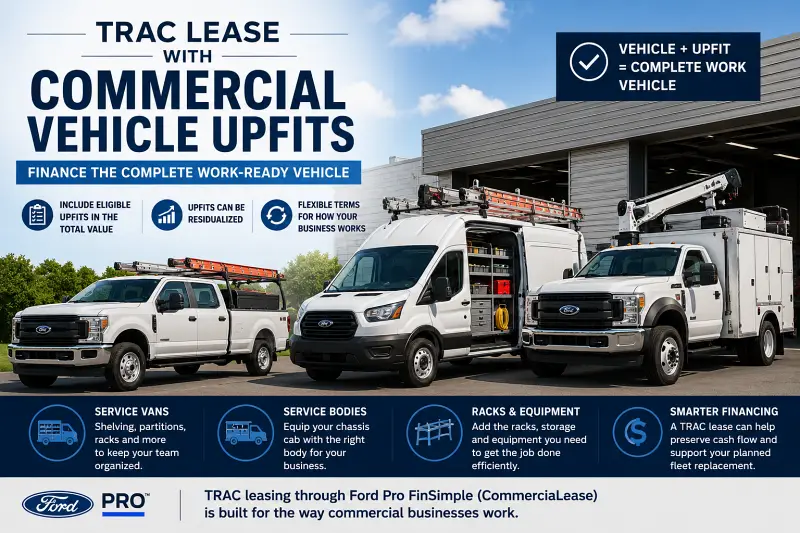
A Ford CommerciaLease TRAC lease can allow eligible commercial upfits to be included with the vehicle, helping businesses finance the complete work-ready truck or van instead of looking only at the base vehicle.
Can Commercial Vehicle Upfits Be Included in a TRAC Lease?
Yes. Ford states that under CommerciaLease, eligible commercial upfits can be included in the total vehicle value and can be residualized as part of the lease structure, subject to applicable Ford Pro FinSimple requirements and approval.
This can be especially useful because many businesses are not simply purchasing a truck or van.
They are purchasing a complete work vehicle.
A Ford Transit may need shelving, partitions, racks and tool storage before a technician can use it. A Ford Super Duty chassis cab may need a service body, dump body, flatbed or other commercial equipment before it can perform the job it was purchased for.
That means the true investment is often much higher than the price of the base vehicle alone.
How a TRAC Lease Works With Commercial Vehicle Upfits
The easiest way to understand the process is to look at the vehicle and its upfit as one complete business asset.
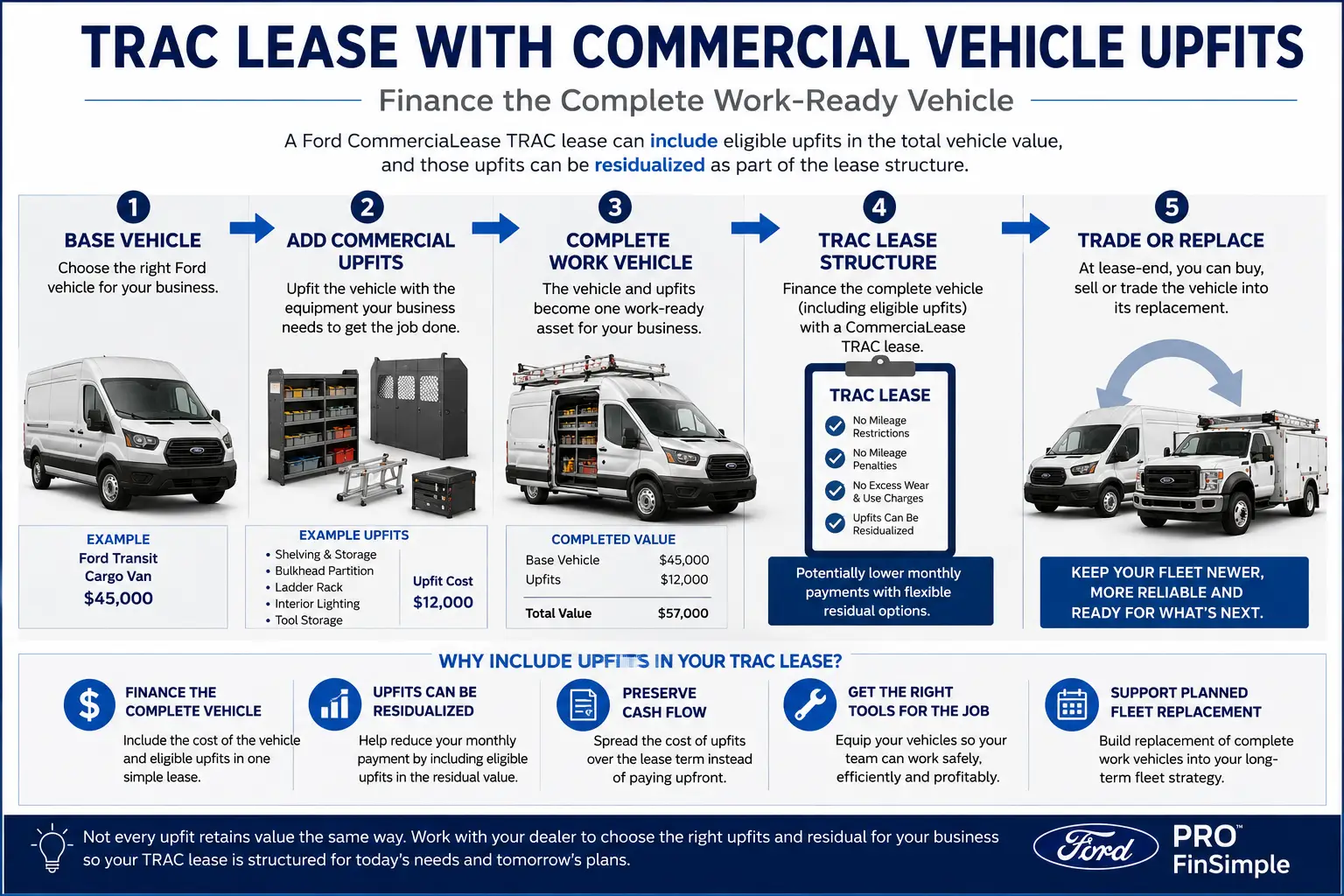
Ford CommerciaLease can allow eligible commercial equipment to be incorporated into the total vehicle value and residualized as part of the lease structure.
What Is a Commercial Vehicle Upfit?
A commercial vehicle upfit is equipment, a body or another modification added to a truck or van so it can perform a specific job.
Common commercial upfits include:
- Van shelving
- Bulkhead partitions
- Ladder racks
- Tool storage
- Interior lighting
- Refrigeration systems
- Service bodies
- Utility bodies
- Dump bodies
- Landscape bodies
- Flatbeds
- Contractor bodies
- Crane bodies
- Other specialized vocational equipment
For many companies, the upfit is what turns a vehicle into a productive piece of equipment.
Think About the Job, Not Just the Vehicle
A plumber does not simply need a cargo van.
The plumber needs a van organized to carry tools, fittings, parts and equipment efficiently.
A utility contractor does not simply need a chassis cab. The company may need a service body with storage compartments, electrical equipment and specialized tools.
Why Including the Upfit Can Matter
Consider a simple example.
Example: Chassis Cab + Service Body
A business purchases a commercial chassis cab for approximately $60,000.
The company then adds a $20,000 service body and related equipment.
The actual vehicle going into service represents an investment of roughly $80,000 before considering taxes, fees and other costs.
From the business owner’s perspective, the $60,000 chassis is not really the completed vehicle.
The $80,000 work-ready truck is.
If eligible upfit costs can be incorporated into the TRAC lease, the business can evaluate the financing structure around the complete work vehicle instead of focusing only on the base chassis.
Vehicle cost and upfit cost should often be evaluated together. The business ultimately needs a work-ready unit, not an unfinished chassis or empty cargo van.
What Does It Mean to Residualize an Upfit?
The residual value is the amount assigned to the vehicle at the end of the lease term.
Ford CommerciaLease allows eligible commercial upfits to be residualized as part of the lease structure.
In simple terms, that means some expected future value may be assigned to qualifying equipment rather than assuming that every dollar spent on the upfit will have no value at lease-end.
That can reduce the amount of the completed vehicle’s value being accounted for through scheduled lease payments.
But the residual needs to make sense.
The goal should not be to residualize as much as possible just to lower the payment. The residual should reflect the realistic future value of the complete vehicle and upfit.
Different Upfits Can Have Different Future Values
Not every piece of commercial equipment retains value the same way.
Consider two work trucks that each receive a $20,000 upfit.
One truck receives a widely used service body that appeals to electricians, plumbers, contractors and service companies.
The other receives highly specialized equipment designed for a very narrow industry.
Both upfits may have cost the same when new, but the future resale market could be very different.
A common service body may appeal to many used commercial vehicle buyers, while highly specialized equipment may have a much smaller market.
A Better Question to Ask
Instead of asking:
“How much of this upfit can we residualize to lower the monthly payment?”
Ask:
“What is this complete work vehicle realistically likely to be worth when the business is ready to replace it?”
Ford Transit With Commercial Shelving
Imagine a service company purchasing a Ford Transit cargo van.
The business adds:
- Interior shelving
- Bulkhead partition
- Ladder rack
- Tool storage
- Interior work lighting
The upfit transforms the Transit from an empty cargo van into a vehicle a technician can use every day.
If the business regularly replaces its service vans, a TRAC lease can allow the vehicle and qualifying equipment to be considered together in the financing structure.
At replacement time, the completed van may also have value to another contractor.
A professionally equipped used commercial van can sometimes be more useful to another business than an empty cargo van because the next owner may be able to put it into service much faster.
Super Duty Chassis Cab With a Service Body
Now consider a contractor purchasing a Ford Super Duty chassis cab.
The company adds a commercial service body with:
- Exterior storage compartments
- Toolboxes
- Ladder storage
- Work lighting
- Hitch equipment
- Electrical equipment
The body may represent a significant portion of the completed truck’s total cost.
Instead of looking at the chassis as one purchase and the service body as an unrelated expense, an eligible TRAC structure may allow the complete work vehicle to be considered together.
That can be particularly useful when a business is ordering several similarly equipped trucks.
Commercial Upfits Can Create a Significant Cash Requirement
The cost becomes even more important when several vehicles are being replaced at once.
Five-Vehicle Example
Imagine a company replacing five service vehicles.
If each vehicle requires $15,000 of shelving, racks, storage and other equipment, the business has approximately $75,000 in upfit costs in addition to the cost of the vehicles themselves.
For a growing company, paying all of those upfit costs separately could consume working capital that might otherwise be used for:
- Payroll
- Inventory
- Hiring
- Equipment
- Marketing
- Expansion
- Other operating expenses
Being able to incorporate eligible upfits into the lease structure may help the company spread the cost of putting those vehicles into service.
Plan the Upfit Before Ordering the Vehicle
One of the biggest mistakes businesses can make is choosing the truck or van first and figuring out the upfit later.
A better commercial vehicle planning process starts with the job the vehicle needs to perform.
Questions worth answering include:
- What will the vehicle carry?
- How much payload is required?
- Will it tow a trailer?
- How many employees need seating?
- What tools and equipment need to be stored?
- Is interior standing height important?
- Does the business need a service body?
- Will electrical equipment be installed?
- Are ladder racks or exterior storage required?
- How will technicians access equipment during the day?
Start with the job. Then choose the vehicle and upfit together. This can help prevent ordering a truck or van that does not properly support the finished work configuration.
Factory Ordering Can Make Upfit Planning Easier
Businesses that plan ahead can often coordinate the vehicle specification and upfit before the vehicle is actually needed.
Instead of purchasing whatever happens to be available and then trying to make it work, the business can follow a planned process:
This can be especially useful when a fleet needs several similarly configured vehicles.
An HVAC company may want every Transit configured with the same shelving layout.
A plumbing company may want tools and fittings stored in the same locations across every van.
A contractor may want every service body built to the same specification.
Standardization can make the fleet easier for employees to use and easier for the business to manage.
TRAC Leasing Can Support a Standardized Fleet
When a company regularly replaces vehicles, standardizing the vehicle and upfit configuration can create several advantages.
- Technicians know where equipment is stored
- Drivers can move between vehicles more easily
- Replacement vehicles can use an established specification
- Parts and equipment planning may become easier
- Fleet managers know what future vehicles should look like
- Upfit planning becomes more repeatable
Vehicle specification → Upfit specification → TRAC lease → Operate → Replace → Repeat
For businesses with several locations or a growing fleet, this consistency can become very valuable.
What Happens to the Upfit at the End of the TRAC Lease?
The upfit is part of the completed commercial vehicle.
As the business approaches replacement time, the value of the complete unit should be considered.
Depending on the lease structure and circumstances, the business may choose to:
- Keep the vehicle
- Sell the vehicle
- Trade the vehicle
- Replace it with another commercial vehicle
If the vehicle is being traded, the dealership can appraise the entire commercial unit, including the value contributed by its body or equipment.
This is where choosing practical and desirable upfits can become important.
A well-maintained service truck or professionally equipped van may appeal to another commercial customer and provide useful pre-owned inventory for the dealership.
Trading an Upfitted TRAC Lease Vehicle
For businesses that regularly replace commercial vehicles, trading the outgoing unit into its replacement can create a practical cycle.
Example: Replacing Three Transit Service Vans
A plumbing company is preparing to replace three Transit service vans.
The dealership appraises the existing vans, including the commercial equipment installed in them.
The business reviews the market value against the applicable lease obligations.
Meanwhile, the replacement Transits may already be factory ordered and scheduled for upfitting.
The dealership may gain useful pre-owned commercial inventory while the business keeps newer work-ready vehicles in service.
Upfits Make Fleet Replacement Planning Even More Important
Replacing a normal pickup may be relatively straightforward.
Replacing a specialized work vehicle can take considerably more planning.
The business may need time for:
- Vehicle ordering
- Production
- Transportation
- Upfit scheduling
- Body installation
- Equipment installation
- Graphics or vehicle wraps
- Final inspection
- Delivery
Waiting until the existing vehicle breaks down can leave the business without the equipment it needs to operate.
Replacement planning should begin before the vehicle becomes urgent. That gives the business time to order, build and upfit the replacement before the outgoing vehicle needs to leave service.
Ford Commercial Line of Credit and Upfitted Vehicles
Businesses acquiring multiple commercial vehicles during the year may also benefit from establishing a Ford Commercial Line of Credit, commonly called CLOC.
A qualified business can establish a pre-approved amount of commercial credit for eligible vehicle purchases and leases, subject to Ford Credit approval and current program requirements.
Ford indicates that CLOC can work with CommerciaLease.
Example: Multiple Vehicle Acquisitions
A business might:
- Order two upfitted service trucks in January
- Add three Transit vans in the spring
- Replace two older trucks in the fall
- Order vehicles for another branch near year-end
Rather than treating every acquisition as an unrelated event, the business can approach its commercial vehicles as part of a broader credit and fleet strategy.
Does Every Upfit Make Sense on a TRAC Lease?
Not necessarily.
Just because commercial equipment may be eligible to be included does not automatically mean TRAC leasing is the best financial structure.
Some equipment may be highly specialized.
Some equipment may have a useful life much longer than the vehicle itself.
Other upfits may have limited resale value.
The business may also plan to operate the vehicle for many years.
The decision should consider:
- Vehicle cost
- Upfit cost
- Lease term
- Expected useful life
- Annual mileage
- Expected equipment life
- Future resale value
- Replacement strategy
- Business cash flow
TRAC Lease vs. Financing an Upfitted Commercial Vehicle
A TRAC lease may be worth considering when the business:
- Regularly replaces vehicles
- Wants to preserve working capital
- Operates high-mileage vehicles
- Uses commercially desirable upfits
- Wants a planned replacement cycle
- Plans to trade vehicles into replacements
Traditional commercial financing may be more appropriate when the company:
- Plans to keep the complete vehicle for a long time
- Uses highly specialized equipment
- Expects the body or equipment to outlast the chassis
- Wants long-term ownership
- Accumulates relatively low annual mileage
Neither option is automatically better. The right structure depends on the completed vehicle, the upfit and how the business intends to use and replace it.
Look at the Complete Work Vehicle, Not Just the Truck
This may be the most important takeaway.
When a business needs an upfitted commercial vehicle, the buying decision should not begin and end with the base truck or van.
Vehicle + Upfit + Financing + Operating Cycle + Replacement
Looking at the complete vehicle can lead to better vehicle selection, better upfit decisions and better long-term fleet planning.
Instead of asking:
“What truck should I buy?”
Ask: “What complete work vehicle does my business need, and what is the best way to put it into service?”
Continue Learning About Commercial TRAC Leasing
Explore the rest of our TRAC Lease Learning Center for more information about residuals, lease-end options, commercial credit, fleet replacement and financing.
TRAC Lease and Commercial Upfit FAQs
Can commercial upfits be included in a Ford TRAC lease?
Ford states that eligible commercial upfits can be included in the total vehicle value under CommerciaLease and can be residualized, subject to applicable program requirements and approval.
What does it mean to residualize an upfit?
Residualizing an upfit means assigning qualifying commercial equipment an expected value at the end of the lease rather than assuming the entire upfit cost has no future value. The residual should reflect the realistic expected value of the complete vehicle.
Can shelving and ladder racks be included in a TRAC lease?
Eligible commercial equipment such as shelving, partitions, racks and other upfit components may be included as part of a CommerciaLease structure, subject to Ford Pro FinSimple requirements and approval.
Can a service body be included in a TRAC lease?
Eligible commercial service bodies and similar vocational equipment may be included in the total vehicle value under Ford CommerciaLease, subject to program requirements and approval.
Does every upfit retain the same residual value?
No. Different upfits can have different future market values. Common service bodies and broadly useful commercial equipment may have a different resale market than highly specialized equipment.
Can I trade an upfitted TRAC lease vehicle?
A dealership can appraise the complete commercial vehicle, including the value contributed by its body or equipment, and compare the market value with the applicable lease obligation when the business is considering a replacement.
Is TRAC leasing always better for an upfitted vehicle?
No. Traditional commercial financing may make more sense when a business plans to keep a vehicle for a long time, uses highly specialized equipment or expects the upfit to outlast the chassis.
Need Help Planning an Upfitted Commercial Vehicle?
Choosing a work vehicle involves more than selecting a truck or van.
Vehicle configuration, payload, commercial equipment, factory ordering, TRAC leasing, financing and replacement timing can all affect whether the completed vehicle actually works for the business.
I can help review the complete requirement, from the Ford vehicle itself to the commercial upfit and financing structure.
That can include planning replacement vehicles before they are urgently needed so the truck or van can be ordered, upfitted and ready when the outgoing vehicle is ready to leave service.
The goal is to put a complete work-ready vehicle into service, not simply sell the business a chassis.