TRAC Lease vs. Financing: Which Is Better for a Business Vehicle?
A TRAC lease and traditional commercial financing can both work well for business vehicles, but they are designed around different goals: planned replacement versus long-term ownership.
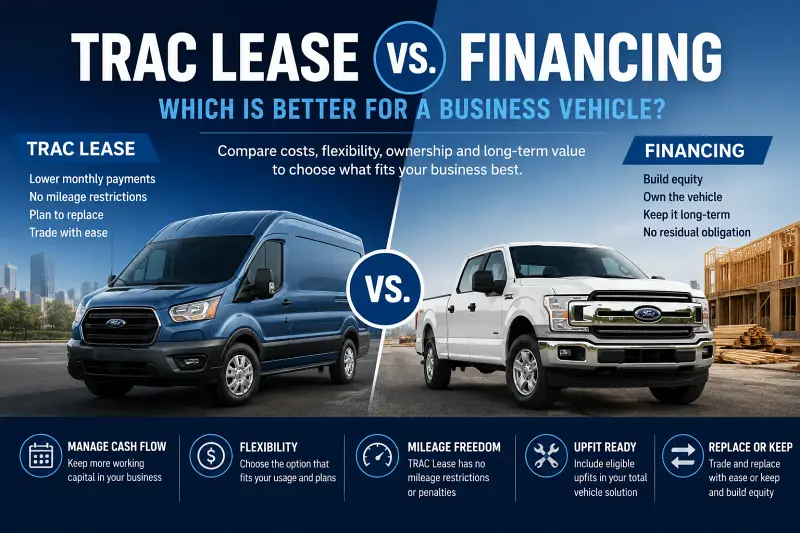
Should a Business TRAC Lease or Finance Its Commercial Vehicles?
When a business needs a new truck or van, one of the biggest decisions is how to pay for it.
Should the company use traditional commercial financing and work toward owning the vehicle outright?
Or should it use a TRAC lease and structure the vehicle around a residual value and planned replacement cycle?
There is no single answer that works for every business.
A company that plans to keep a specialized truck for ten years may reach a very different conclusion than a service company replacing high-mileage vans every four or five years.
The better question is not, “Is leasing better than financing?” It is, “Which option fits how my business plans to use, operate and eventually replace this vehicle?”
TRAC Lease vs. Financing at a Glance
The easiest way to understand the difference is to look at what each structure is designed to accomplish.
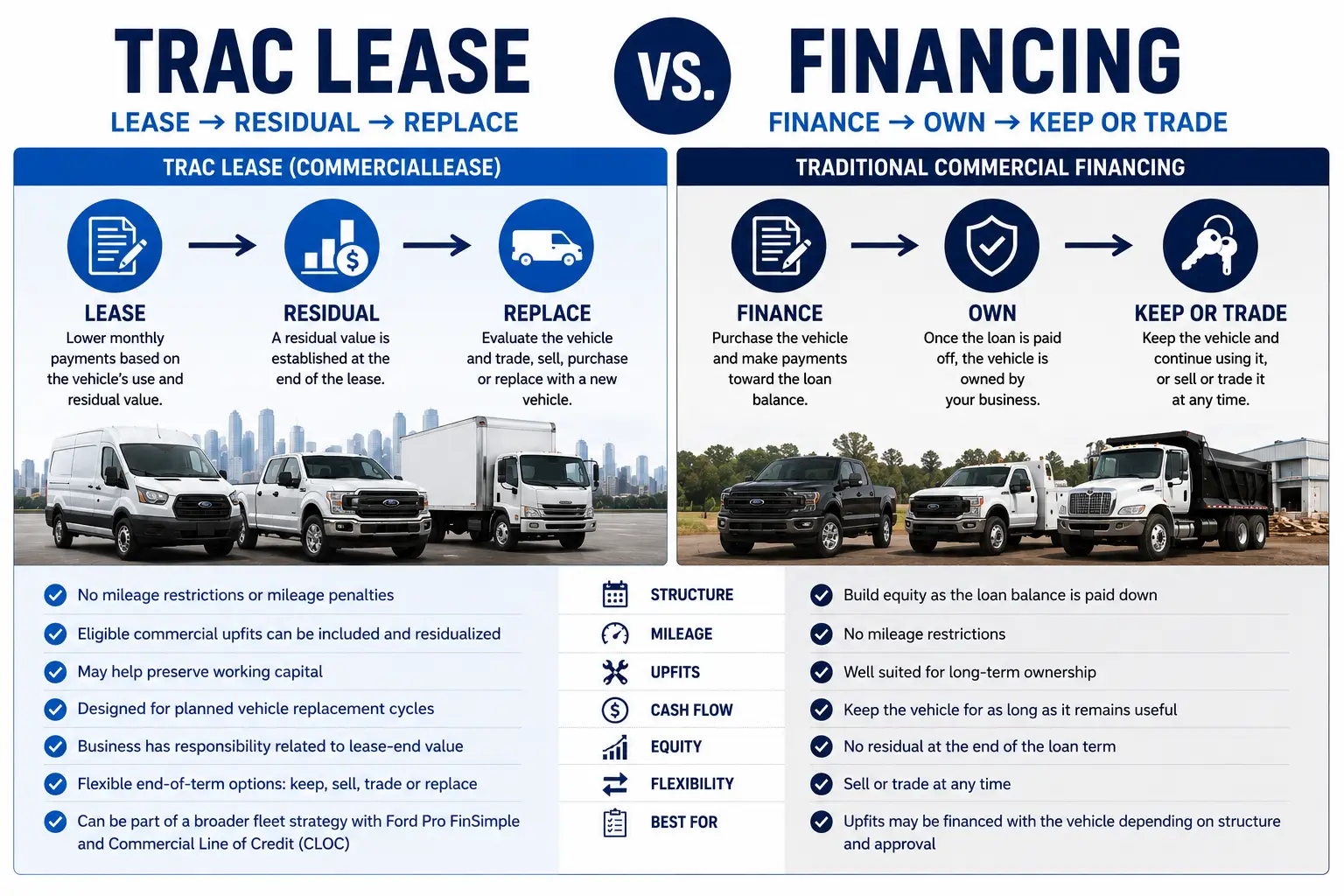
TRAC leasing is built around residual value and replacement planning, while traditional financing is built around ownership.
Quick Comparison: TRAC Lease vs. Traditional Financing
| Consideration | TRAC Lease | Traditional Financing |
|---|---|---|
| Structure | Lease with residual value | Purchase financed through a loan |
| Ownership | Lease structure | Business owns the vehicle as loan is paid down |
| Residual | Residual remains at lease-end | No lease residual |
| Mileage | No mileage restrictions or penalties under Ford CommerciaLease | No lease mileage restrictions |
| Commercial Upfits | Eligible upfits can be included and residualized | May be financed depending on structure and approval |
| Long-Term Ownership | Not usually the main purpose | Strong fit for keeping the vehicle long-term |
| Replacement Planning | Naturally supports planned replacement cycles | Business decides when to sell or trade |
Ownership
Traditional Commercial Financing
With traditional financing, the business purchases the vehicle and makes payments toward the loan balance.
Once the loan is paid off, the business can continue operating the vehicle without that loan payment.
That can be very attractive for companies that plan to keep commercial vehicles for many years.
TRAC Lease
A TRAC lease is structured differently.
Ford Credit offers its TRAC lease through Ford Pro FinSimple under the CommerciaLease program.
A residual value remains at lease-end, and that residual becomes part of the overall payment and replacement strategy.
Rather than focusing primarily on ownership, TRAC leasing can work well when the business already expects to replace the vehicle on a planned schedule.
Financing is naturally built around ownership. TRAC leasing is naturally built around vehicle use and future replacement.
Monthly Payment
Monthly payment is often where the comparison begins, but it should not be where it ends.
Traditional Financing
Commercial loan payments can depend on:
- Vehicle price
- Amount financed
- Down payment
- Interest rate
- Loan term
- Taxes and fees
- Eligible upfit costs
TRAC Lease
A TRAC lease considers factors such as:
- Vehicle cost
- Upfit cost
- Lease term
- Lease rate
- Residual value
- Current Ford Pro FinSimple requirements
Because a residual remains at lease-end, a TRAC lease may result in a lower scheduled monthly payment than financing the same vehicle over a comparable period.
But the residual does not disappear.
A lower monthly payment should never be evaluated without also looking at the remaining residual and what the business plans to do with the vehicle later.
A Simple $70,000 Commercial Truck Example
Traditional Financing
The business finances the applicable purchase amount and makes payments toward the loan balance.
Once the loan has been paid as agreed, the vehicle can continue operating without that loan payment.
The company may then:
- Keep the truck
- Sell it
- Trade it
- Move it into another role in the fleet
TRAC Lease
A residual value remains at the end of the selected lease term.
Because the scheduled payments are not structured like a conventional fully amortizing vehicle loan, the monthly payment may be lower depending on the residual and lease structure.
At replacement time, the business evaluates the vehicle’s actual market value compared with the applicable lease obligation.
If the company is ready for another truck, the current vehicle can potentially be traded into its replacement.
The important difference is not simply how much the payment is today. It is what the business wants to happen to the truck several years from now.
How Long Will Your Business Keep the Vehicle?
This may be one of the most useful questions to answer before comparing any payments.
If You Plan to Keep the Vehicle a Long Time
Traditional financing may be the more natural fit.
Imagine a company purchases a specialized truck and expects to operate it for ten or twelve years.
After the loan is paid off, the company may continue using that truck for several additional years without a vehicle payment.
If You Replace Vehicles Regularly
TRAC leasing may fit more naturally.
A service company might replace Transit vans every four or five years because they accumulate substantial mileage and are highly visible to customers.
Cash Flow
Commercial vehicles can tie up a significant amount of business capital.
This becomes particularly important when a company needs several vehicles at once.
Example: Growing Contractor
A contractor needs five additional work trucks.
At the same time, the company also needs cash for employees, tools, inventory, equipment and growth.
Depending on the transaction, TRAC leasing may allow the business to structure vehicle expenses differently and preserve more working capital.
Traditional financing can also be structured with different loan terms and down payments.
The right decision should consider the company’s overall cash needs rather than viewing the vehicle payment by itself.
Mileage
This is one area where both structures can work well for high-mileage businesses.
Traditional Financing
There are no lease mileage limits because the business is purchasing the vehicle.
Ford CommerciaLease TRAC
Ford states that CommerciaLease has no mileage restrictions or mileage penalties.
That gives a business the mileage freedom of a commercial vehicle without using a closed-end lease with a preset mileage allowance.
A technician may drive 25,000 miles one year and 40,000 the next.
Under CommerciaLease, the vehicle can continue serving the business without an excess-mileage penalty.
Commercial Vehicle Upfits
Commercial equipment can represent a large part of the completed work vehicle’s total investment.
A Ford Transit might need:
- Shelving
- Partitions
- Ladder racks
- Tool storage
A Super Duty chassis cab might need:
- Service body
- Dump body
- Flatbed
- Landscape body
- Utility equipment
TRAC Lease
Ford states that eligible commercial upfits can be included in the total vehicle value under CommerciaLease and can be residualized.
Traditional Financing
Commercial upfits may also be incorporated into a traditional commercial financing structure depending on the transaction, lender requirements and approval.
The important difference is that traditional financing does not use the same TRAC residual structure.
What Happens After a Financed Vehicle Is Paid Off?
This is one of the strongest arguments for traditional financing.
Once the loan is paid off, the business can continue operating the vehicle without that loan payment.
For some companies, that is exactly the plan.
They purchase vehicles, pay them off and continue operating them for several additional years.
Long-term ownership can be very cost-effective when the vehicle remains reliable, productive and inexpensive to maintain.
A Paid-Off Vehicle Is Not Necessarily a Cheap Vehicle
Eliminating vehicle payments can be attractive, but aging vehicles can create other costs.
Those may include:
- Repairs
- Unexpected downtime
- Towing
- Rental vehicles
- Lost technician productivity
- Missed appointments
- Higher maintenance expenses
- Reduced fuel efficiency
- Employee frustration
Think About Downtime
A service van may be fully paid off, but if it spends several days each month in the repair shop, the business still has a significant vehicle cost.
The lost productivity from a technician without a working vehicle can sometimes cost more than the repair itself.
This is why fleet replacement decisions should consider total operating cost, not simply whether the vehicle has a payment.
Fleet Replacement Planning
TRAC leasing can naturally support businesses that want a structured replacement schedule.
Imagine a company operating 30 vehicles.
Instead of waiting until vehicles become unreliable, the company may plan replacements over several years.
Example Replacement Schedule
Year 1: Replace 5 vehicles
Year 2: Replace 6 vehicles
Year 3: Replace 4 vehicles
The business can plan:
- Factory orders
- Commercial upfits
- Financing
- Trade values
- Budgets
- Delivery timing
Traditional financing can also be used with a fleet replacement strategy.
The difference is that TRAC leasing is naturally structured around a residual and future vehicle disposition.
Trading the Vehicle
Both financed and TRAC-leased vehicles can potentially be traded when the business is ready for replacement.
Financed Vehicle
The dealership can appraise the vehicle and compare its current market value against any remaining loan payoff.
If the vehicle is worth more than the payoff, the business may have positive equity.
If the payoff exceeds the vehicle’s value, the company will need to determine how to handle the difference.
TRAC Lease Vehicle
The dealership can also appraise a TRAC lease vehicle and compare its market value with the applicable lease obligation.
For companies using a regular replacement cycle, the current truck or van may potentially be traded when the replacement vehicle arrives.
Vehicle Appearance and Company Image
Vehicle replacement is not purely a financial decision.
Commercial vehicles often represent the company everywhere they go.
A truck or van may display:
- Company name
- Logo
- Phone number
- Website
- Vehicle graphics
- Services offered
Customers see those vehicles on the road, at jobsites and parked in front of homes and businesses.
A newer, clean and professional-looking fleet can reinforce the company’s image.
Newer vehicles may also provide access to:
- Newer safety technology
- Driver-assistance features
- Connectivity
- Telematics
- Productivity tools
- Improved efficiency
TRAC leasing can support a regular replacement cycle, while financing can be a strong fit when the business prefers to keep vehicles much longer.
Plumbing Company With Transit Service Vans
Consider a plumbing company operating 15 Ford Transit vans.
Each vehicle:
- Travels approximately 30,000 miles per year
- Carries shelving and commercial equipment
- Has company graphics
- Visits customer homes every day
- Is expected to be replaced every four to five years
TRAC leasing may fit this type of business very well.
The vehicles accumulate substantial mileage, upfits are part of the cost, appearance matters and the business already follows a regular replacement cycle.
Specialty Contractor With a Long-Life Work Truck
Now consider a contractor purchasing a specialized Super Duty work truck.
The vehicle:
- Receives an expensive specialized body
- Travels relatively low annual mileage
- Is expected to remain in service for ten years
- Uses equipment that may outlast a normal vehicle replacement cycle
Traditional commercial financing may make more sense.
Once the truck is paid off, the company may continue using it productively for many additional years.
The job the vehicle performs should help determine the financing structure.
A Mixed Fleet May Use Both TRAC Leasing and Financing
Many businesses should not choose only one financing method for every vehicle.
Example Mixed Fleet
The company operates:
- 12 Transit service vans
- 6 F-150 field trucks
- 3 specialized Super Duty trucks
- 4 management vehicles
The company might choose:
TRAC Lease: Transit service vans
TRAC Lease: High-mileage F-150s
Traditional Financing: Specialized Super Duty trucks
Red Carpet Lease: Predictable-mileage management vehicles
There is no rule saying every vehicle must use the same financing structure.
In many fleets, using different structures for different jobs can make more sense.
Ford Commercial Line of Credit Can Support a Mixed Strategy
This becomes especially useful when a business operates several vehicles and expects to acquire more throughout the year.
Ford Commercial Line of Credit, commonly called CLOC, can provide qualified businesses with a pre-established amount of commercial credit for eligible purchases and leases, subject to Ford Credit approval and current program requirements.
That can allow a business to use different financing structures for different vehicles.
Vehicle #1 → TRAC Lease
Vehicle #2 → Traditional Financing
Vehicle #3 → TRAC Lease
Vehicle #4 → Traditional Financing
The financing structure can be chosen based on what makes sense for each vehicle while remaining part of a larger commercial credit strategy.
What About Tax Benefits?
Business owners often ask whether leasing or financing provides better tax treatment.
That can be an important consideration, but the answer depends on the business, accounting method, vehicle use and applicable tax law.
Businesses should discuss their specific situation with a qualified tax or accounting professional.
The financing decision should still consider:
- Cash flow
- Vehicle use
- Mileage
- Replacement cycle
- Upfit costs
- Ownership goals
- Expected resale value
- Total operating cost
Do not choose a vehicle financing structure based only on a general tax assumption.
When Might a TRAC Lease Be Better?
A TRAC lease may deserve stronger consideration when:
- The business replaces vehicles regularly
- Annual mileage is high
- Annual mileage is unpredictable
- The company wants to preserve working capital
- Commercial upfits are required
- The business wants a structured replacement plan
- Vehicles are regularly traded into replacements
- Fleet appearance is important
- The company understands residual-value responsibility
When Might Traditional Financing Be Better?
Traditional financing may deserve stronger consideration when:
- The business wants long-term ownership
- The vehicle will remain in service for many years
- Annual mileage is relatively low
- The business wants to operate the vehicle after payments end
- The vehicle uses highly specialized equipment
- The upfit may outlast a normal replacement cycle
- The business prefers ownership over leasing
- The vehicle is expected to remain useful well beyond the financing term
Don’t Compare Only Monthly Payments
This may be the most important part of the entire comparison.
Option A: $1,200 monthly payment
Option B: $950 monthly payment
It is tempting to assume Option B is automatically better.
But the two payments may represent completely different structures.
One may result in full ownership.
The other may leave a significant residual.
One may be designed around keeping the vehicle for ten years.
The other may be designed around replacing it after four years.
The better comparison is: “What will this vehicle cost my business during the years I actually plan to operate it?”
Think in Terms of the Vehicle’s Full Life Cycle
Instead of thinking only about financing, consider the complete vehicle life cycle.
Acquire → Operate → Maintain → Evaluate → Replace or Keep
Then ask which financing structure best supports that plan.
Long-Term Vehicle
Finance → Pay Off → Continue Operating
High-Mileage Service Vehicle
TRAC Lease → Operate → Trade → Replace
Both can be good strategies.
The best answer depends on how the business actually uses its fleet.
Continue Learning About Commercial TRAC Leasing
Explore our complete TRAC Lease Learning Center for more information about benefits, commercial upfits, lease-end options, payments and Ford Commercial Line of Credit.
Estimate a TRAC Lease Payment
Use our TRAC Lease Calculator to see how vehicle price, term, residual and rate assumptions can affect an estimated payment.
You can then compare the estimated lease structure with traditional commercial financing.
TRAC Lease vs. Financing FAQs
Is a TRAC lease cheaper than financing?
Not necessarily. A TRAC lease may have a lower scheduled monthly payment because a residual remains at lease-end, but the business should compare the complete transaction rather than monthly payment alone.
Which is better if I plan to keep the vehicle for a long time?
Traditional commercial financing may be a stronger fit when the business plans to keep the vehicle well beyond the financing term and continue operating it after the loan is paid off.
Which is better for high-mileage commercial vehicles?
Both can work for high mileage. Traditional financing has no lease mileage limit, and Ford states that CommerciaLease also has no mileage restrictions or mileage penalties.
Can commercial upfits be included in a TRAC lease?
Ford states that eligible commercial upfits can be included in the total vehicle value under CommerciaLease and can be residualized, subject to current program requirements and approval.
Can commercial upfits be financed with a traditional loan?
Commercial upfits may be financed with the vehicle depending on the financing structure, lender requirements and approval.
Can I trade a TRAC lease vehicle before replacing it?
A dealership can appraise the vehicle and compare its market value with the applicable lease obligation when the business is planning a replacement.
Can a business use both financing and TRAC leasing?
Yes. Many businesses may benefit from using different financing structures for different vehicles depending on mileage, expected ownership period, upfits and replacement plans.
Does Ford Commercial Line of Credit work with TRAC leasing and financing?
Ford Commercial Line of Credit can support eligible commercial vehicle purchases and leases for qualified businesses, subject to Ford Credit approval and current program requirements.
Should You TRAC Lease or Finance Your Next Commercial Vehicle?
There is no reason to guess based only on a monthly payment.
We can look at the actual vehicle your business needs, expected mileage, commercial upfits, how long you plan to keep it and when you normally replace vehicles.
From there, we can compare a TRAC lease structure with traditional commercial financing.
For businesses operating several vehicles, we can also look at the decision across the entire fleet rather than evaluating one truck at a time.
The best financing option is the one that fits how your business actually plans to use the vehicle.