What Happens at the End of a TRAC Lease?
At the end of a Ford CommerciaLease TRAC lease, a business may have several options, including keeping, selling, trading or replacing the vehicle.
TRAC Lease-End Is Different From a Traditional Lease
One of the most important things to understand about a TRAC lease is what happens when the lease term ends.
Unlike a traditional closed-end lease, where the customer may simply return the vehicle after meeting the lease requirements, a TRAC lease gives the business more flexibility at lease-end.
Ford Credit offers its TRAC lease through Ford Pro FinSimple under the CommerciaLease program.
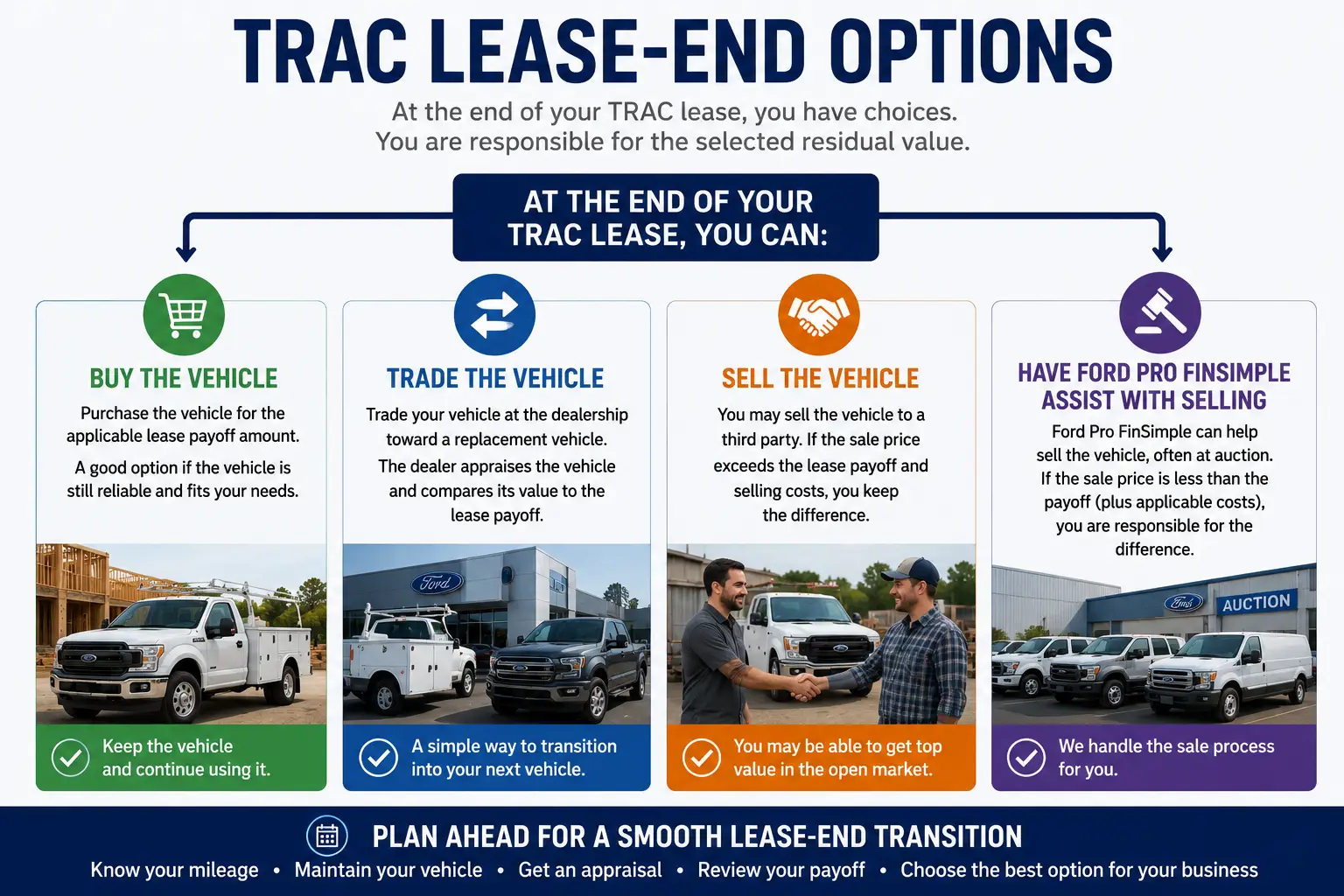
Depending on the situation and applicable lease terms, the business may be able to:
- Buy or keep the vehicle
- Sell the vehicle
- Trade the vehicle
- Replace it with another commercial vehicle
- Have Ford Pro FinSimple assist with selling the vehicle
The business also has responsibility related to the selected residual value at lease-end.
Your Main TRAC Lease-End Options
A TRAC lease gives a business several possible paths at the end of the term. The right choice depends on the vehicle’s condition, market value, lease payoff and the company’s future fleet needs.
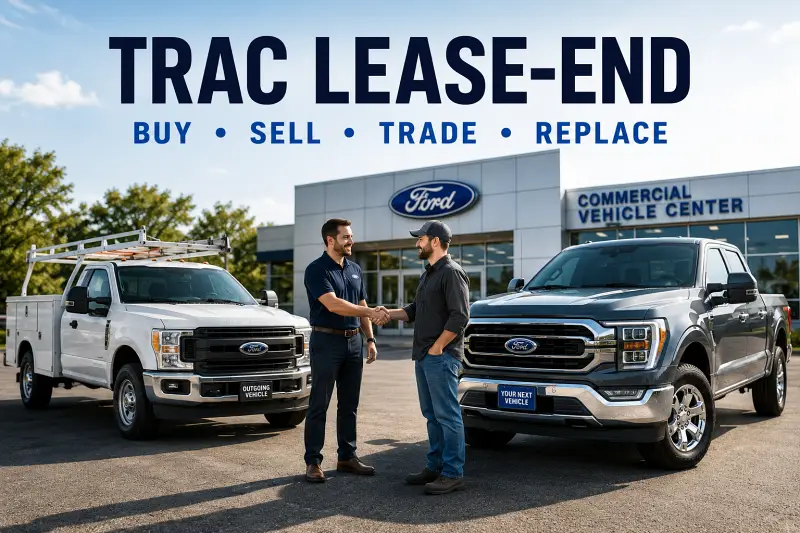
At the end of a TRAC lease, the business can evaluate whether buying, selling, trading or replacing the commercial vehicle makes the most sense.
The Residual Value Matters at Lease-End
Every TRAC lease includes a residual value.
The residual is the amount assigned to the vehicle at the end of the lease term.
Under a standard CommerciaLease TRAC structure, the business has responsibility related to that remaining value.
This is why the residual should be considered carefully when the lease is first structured.
A higher residual may lower the scheduled monthly payment, but it also leaves a larger amount at lease-end.
A realistic residual should consider:
- Vehicle type
- Expected mileage
- Commercial use
- Vehicle condition
- Commercial upfits
- Lease term
- Replacement timing
- Expected future market value
The best residual is not necessarily the highest one. It should make sense for the vehicle and the way the business plans to use and replace it.
Buy or Keep the Vehicle
One option is to keep the vehicle.
If the truck or van is still reliable, still fits the business and still has useful life remaining, keeping it may make more sense than replacing it simply because the lease term has ended.
Keeping the vehicle may be worth considering when:
- The vehicle remains reliable
- Mileage is reasonable for its age
- Maintenance costs remain manageable
- The business still needs the vehicle
- The commercial upfit has useful life remaining
- Replacement is not currently necessary
- The vehicle is worth keeping
Example
A contractor has a Super Duty service truck that has been maintained extremely well.
The body and equipment are still useful, mileage is lower than expected and the truck continues to perform its job reliably.
In that situation, keeping the vehicle may make more sense than replacing it simply because the lease term has ended.
Trade the Vehicle Into Its Replacement
For many businesses that regularly replace vehicles, trading the vehicle may be one of the most practical lease-end options.
Before replacement, the dealership can appraise the current vehicle and compare its market value with the applicable lease obligation.
The appraisal may consider:
- Current market value
- Mileage
- Vehicle condition
- Commercial upfits
- Remaining lease obligation
- Demand for that type of used commercial vehicle
If the business already has another commercial vehicle available or on order, the current truck or van may potentially be traded as part of the replacement transaction.
For businesses that regularly replace vehicles, TRAC lease-end can become part of an ongoing fleet replacement cycle rather than a one-time event.
Why a Dealer May Want the Trade
There can also be a benefit for the dealership when a business trades a commercial vehicle.
Good used commercial vehicles can be difficult to find.
A well-maintained Transit service van, F-150 work truck or Super Duty service-body truck may be valuable pre-owned inventory.
The dealership may be able to:
- Appraise the vehicle
- Recondition it
- Offer it as pre-owned commercial inventory
- Sell it to another business that needs a work vehicle immediately
Meanwhile, the original customer moves into a newer commercial vehicle.
The dealer may gain useful pre-owned inventory while the business keeps newer vehicles in service.
Keeping the Fleet Looking Professional
Trading vehicles regularly can provide another benefit that has little to do with the lease itself.
Commercial vehicles often represent the business everywhere they go.
A work truck or van may display:
- Company name
- Logo
- Phone number
- Website
- Services
- Vehicle graphics
Customers may see those vehicles every day.
A newer, clean and professional-looking fleet can help reinforce the image the company wants to present.
Newer vehicles may also provide access to:
- Newer safety technology
- Driver-assistance systems
- Connectivity
- Telematics
- Productivity tools
- Improved efficiency
That does not mean every vehicle should automatically be replaced.
But fleet appearance and vehicle technology can be part of the lease-end decision.
Sell the Vehicle
A business may also choose to sell the vehicle rather than trade it.
This may be worth considering if the company believes it can obtain a stronger market value from a third-party buyer.
For example, a specialized commercial vehicle may have strong demand within a particular industry.
A contractor may already know another business that wants to buy the truck.
Before selling, the business should understand the applicable payoff process and lease requirements.
Get the payoff information first. Then compare the expected selling price with the lease obligation and any applicable selling costs.
Have Ford Pro FinSimple Assist With Selling the Vehicle
Ford Pro FinSimple may also assist with selling the CommerciaLease vehicle.
In some situations, the vehicle may be sold through an auction process.
This is where residual responsibility becomes especially important.
Simple Example
Suppose the applicable lease payoff is $30,000.
If the vehicle sells for $27,000 and there are applicable selling or disposal costs, the business may be responsible for the shortfall.
This is one reason it can be useful to understand the vehicle’s current market value before deciding which lease-end path to take.
What If the Vehicle Is Worth More Than the Lease Obligation?
This can put the business in a stronger lease-end position.
Example
Suppose the applicable lease obligation is $25,000.
The dealership appraises the vehicle at $30,000.
The vehicle’s market value may exceed the amount needed to satisfy the lease obligation, which can become part of the trade discussion toward the next commercial vehicle.
This is why getting an appraisal before making a lease-end decision can be useful.
What If the Vehicle Is Worth Less Than the Lease Obligation?
The opposite can also happen.
Example
Suppose the applicable lease obligation is $30,000.
The vehicle’s current market value is only $26,000.
The business may be responsible for the difference depending on the applicable lease terms and disposition method.
Several factors can contribute to a lower value:
- Higher-than-expected depreciation
- Poor vehicle condition
- Accident history
- Very high mileage
- Weak used-vehicle demand
- Highly specialized commercial equipment
- An overly aggressive original residual
A low monthly payment created by an unrealistic residual can become a problem several years later.
Vehicle Condition Still Matters
Ford CommerciaLease does not have the traditional excess wear-and-use charges associated with many closed-end leases.
But that does not mean condition is irrelevant.
Vehicle condition affects market value.
A clean, well-maintained commercial vehicle with good tires, proper maintenance history and a professionally installed upfit may be much easier to sell or trade than a neglected vehicle.
Good vehicle maintenance can help protect the vehicle’s future market value.
Commercial Upfits Can Affect Lease-End Value
The upfit can be an important part of the complete vehicle’s market value.
A service body, shelving package, refrigeration system or other commercial equipment may add value to the vehicle.
But not every upfit has the same resale market.
A commonly used service body may appeal to many contractors.
Highly specialized equipment may appeal to a much smaller group of buyers.
At lease-end, think about the complete unit: vehicle + upfit + condition + mileage + market demand.
Do Not Wait Until the Last Month to Plan
For a business that depends on its vehicles, lease-end planning should begin well before the final payment is due.
The business should review:
- Current mileage
- Vehicle condition
- Repair history
- Expected future maintenance
- Current market value
- Replacement vehicle availability
- Factory-order timing
- Commercial upfit lead time
- Expected company growth
If a replacement vehicle needs to be factory ordered and upfitted, planning may need to begin months in advance.
Lease-end planning should begin before the vehicle becomes urgent to replace.
Five Transit Vans Approaching Replacement
Imagine an HVAC company has five Transit vans approaching replacement next year.
Instead of waiting until each lease ends, the business can start planning now.
The company can keep the current vans in service while the new vehicles are being produced and upfitted.
When the replacements are ready, the outgoing vans can be appraised and the company can decide whether trading them makes sense.
Trading Into a Factory-Ordered Replacement
This can be one of the most useful ways to manage a TRAC lease-end.
Suppose the business knows a Transit van should be replaced in approximately eight months.
Instead of waiting eight months to begin shopping, the company can plan the replacement earlier.
The replacement can be ordered with the correct:
- Vehicle configuration
- Options
- Commercial shelving
- Ladder racks
- Equipment
- Graphics
While the new vehicle is being produced and upfitted, the existing van remains in service.
Old van is appraised → TRAC position is reviewed → Old van is traded → New van goes into service.
How TRAC Leasing Can Support Predictable Fleet Replacement
For businesses operating several vehicles, planned replacement can spread vehicle needs over time.
Example: 30-Vehicle Fleet
Year 1: Replace 5 vehicles
Year 2: Replace 6 vehicles
Year 3: Replace 4 vehicles
Year 4: Replace 7 vehicles
The company can plan:
- Capital requirements
- Monthly vehicle costs
- Factory orders
- Commercial upfits
- Trade values
- Delivery timing
- Employee growth
TRAC leasing can become one part of that larger fleet strategy.
How Ford Commercial Line of Credit Can Fit Into the Replacement Cycle
Businesses acquiring several vehicles during the year may also consider Ford Commercial Line of Credit, commonly called CLOC.
Ford describes CLOC as a pre-established amount of commercial credit that qualified businesses can use for eligible commercial vehicle purchases and leases, subject to approval and current program requirements.
Example Replacement Year
January: Replace two service vans
April: Add one F-150
August: Replace two Super Duty trucks
November: Order next year’s vehicles
Instead of treating each vehicle as an unrelated credit event, the business may be able to use a broader commercial credit strategy.
Buy, Sell or Trade: Which Lease-End Option Is Best?
Consider Buying When:
- The vehicle remains reliable
- Maintenance costs are reasonable
- The vehicle still fits the business
- The commercial upfit has useful life remaining
- Replacement is unnecessary
- The business wants to keep the asset
Consider Trading When:
- The business already plans to replace the vehicle
- A replacement vehicle is available or on order
- The dealership provides a competitive appraisal
- The business wants a simple transition
- Keeping newer vehicles is part of the fleet strategy
Consider Selling When:
- The vehicle has strong third-party demand
- A specialized buyer may pay more
- The company is comfortable managing the sale process
Consider Ford Pro FinSimple Sale Assistance When:
- The business does not want to manage the sale itself
- The company understands potential shortfall responsibility
- Applicable auction and disposal costs are understood
The best decision starts with knowing the vehicle’s actual market value and the applicable lease payoff.
Get the Vehicle Appraised Before Making the Decision
One of the best things a business can do as lease-end approaches is get an appraisal.
That gives the company real information to work with.
Current Market Value
versus
Applicable Lease Payoff
From there, the business can decide whether the best option is:
- Keep
- Sell
- Trade
- Replace
A good lease-end decision should be based on numbers rather than assumptions.
TRAC Lease-End vs. Red Carpet Lease-End
TRAC lease-end is very different from a traditional closed-end Red Carpet Lease.
TRAC Lease
The business has greater flexibility around what happens to the vehicle, including potentially buying, selling or trading it.
The business also has responsibility related to the residual value.
Red Carpet Lease
Red Carpet Lease follows a more traditional closed-end structure.
The customer may generally return the vehicle, purchase it or move into another vehicle according to the applicable lease terms.
Mileage and excess wear-and-use requirements may also apply.
Continue Learning About Commercial TRAC Leasing
Explore the rest of our TRAC Lease Learning Center for information about benefits, upfits, financing, payments and commercial credit.
TRAC Lease-End FAQs
What happens at the end of a TRAC lease?
Depending on the applicable lease terms and circumstances, a business may be able to buy or keep the vehicle, sell it, trade it, replace it or have Ford Pro FinSimple assist with selling it.
Who is responsible for the residual value at the end of a TRAC lease?
Under a standard Ford CommerciaLease TRAC structure, the business has responsibility related to the selected residual value at lease-end.
Can I trade a TRAC lease vehicle?
A dealership can appraise the vehicle and compare its current market value with the applicable lease obligation so the business can determine whether trading it into a replacement vehicle makes sense.
Can I buy my TRAC lease vehicle?
Depending on the applicable lease terms, the business may be able to obtain a payoff and keep the vehicle when the lease ends.
What happens if the TRAC lease vehicle is worth less than the residual?
If the vehicle’s market value is below the applicable lease obligation, the business may be responsible for the difference depending on the lease terms and how the vehicle is sold or disposed of.
What happens if the vehicle is worth more than the lease obligation?
If the vehicle’s current market value exceeds the applicable lease obligation, that stronger market position may be considered when the business sells or trades the vehicle.
Should I wait until the end of the lease to order my replacement vehicle?
Usually it is better to plan earlier, especially if the replacement needs to be factory ordered or commercially upfitted. Starting early can help reduce downtime and allow the outgoing vehicle to remain in service until the replacement is ready.
Planning for the End of Your TRAC Lease?
The best time to think about lease-end is before the vehicle is actually due for replacement.
We can review the vehicle’s mileage, condition, current market value, applicable lease obligation, maintenance history and your upcoming business needs.
We can also look at replacement timing, factory ordering and commercial upfits so the next truck or van can be ready when the outgoing vehicle needs to leave service.
For businesses operating several vehicles, we can review upcoming replacement needs across the entire fleet instead of dealing with each vehicle at the last minute.
Lease-end should not be a surprise. It should be another planned step in the life cycle of the vehicle.