How Are TRAC Lease Payments Calculated?
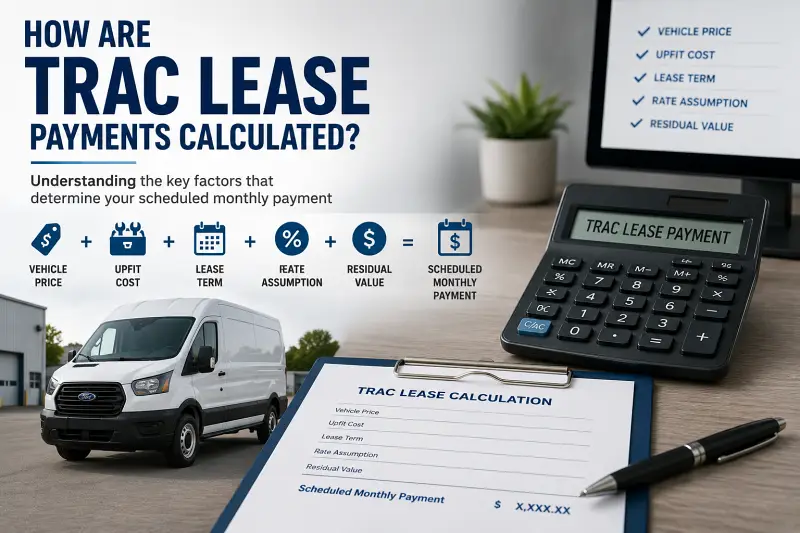
A TRAC lease payment is influenced by several parts of the transaction, including the vehicle price, eligible commercial upfits, lease term, rate and the residual value selected for the vehicle.
What Determines a TRAC Lease Payment?
A commercial vehicle TRAC lease payment generally depends on the amount being leased, the length of the lease, the financing rate and the vehicle’s selected residual value at the end of the term.
Eligible commercial upfits may also be included in the lease structure, depending on the vehicle, equipment and program requirements.
The main factors are:
- Vehicle price
- Eligible commercial upfit cost
- Amount being leased
- Lease term
- Financing rate
- Residual value
- Applicable taxes and fees
Unlike traditional financing, a TRAC lease can leave a planned residual value at the end of the lease instead of paying the entire vehicle balance down toward zero during the original term.
How the Parts of a TRAC Lease Work Together
You do not need to be a finance expert to understand the basic structure.
Think of the TRAC lease payment as the result of several pieces working together rather than one simple vehicle-price calculation.
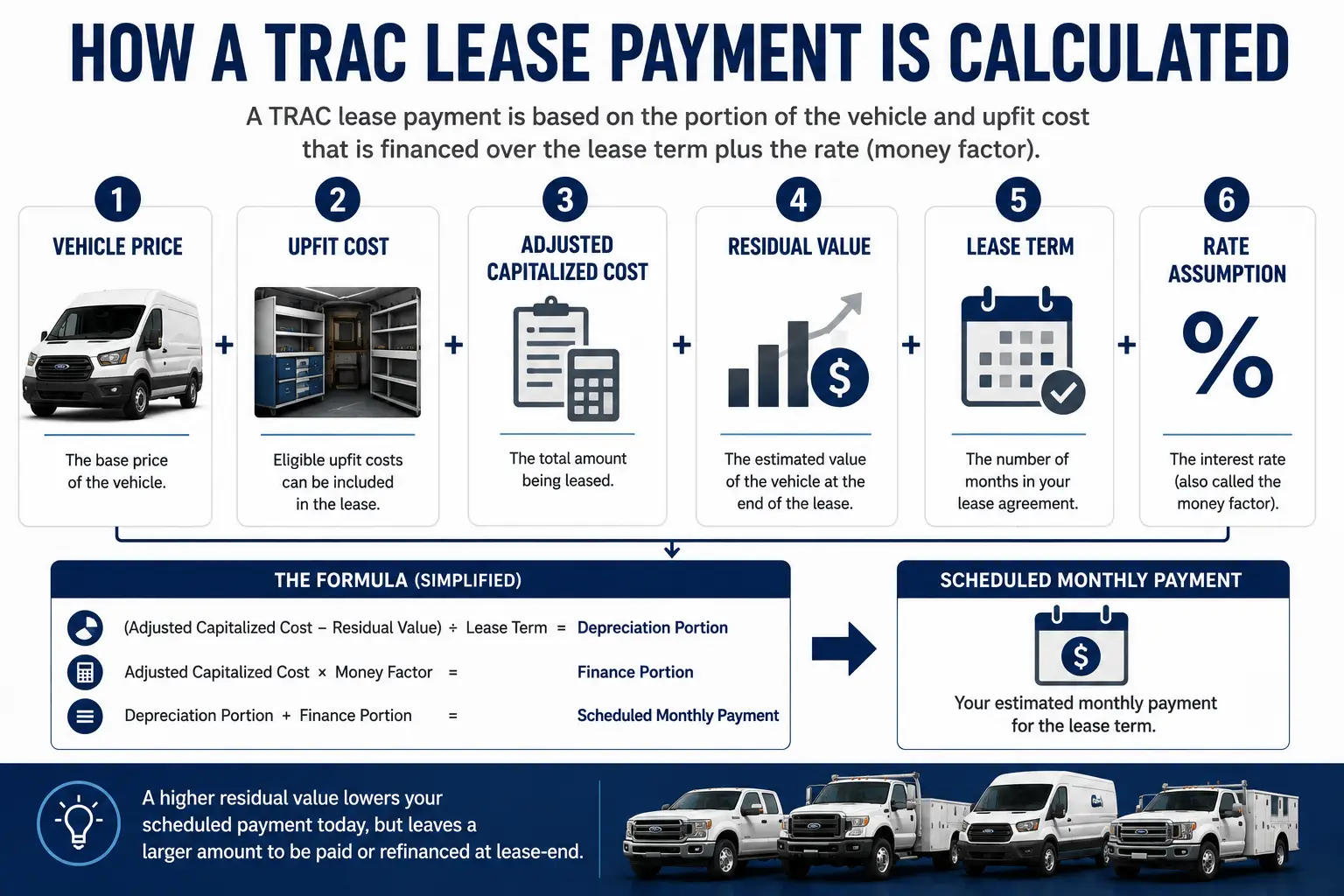
Vehicle cost, eligible commercial upfits, residual value, lease term and rate all help determine the scheduled TRAC lease payment.
Vehicle Price
The starting point is the cost of the commercial vehicle.
A higher-priced truck or van will normally create a larger amount to be leased than a lower-priced vehicle, assuming the other lease terms are similar.
The vehicle amount can be affected by:
- Model
- Trim level
- Engine
- Drivetrain
- Cab and body configuration
- Factory options
- Commercial equipment
- Applicable incentives or pricing programs
This is one reason vehicle selection matters before discussing the lease payment.
The goal should not simply be finding the lowest payment. It should be configuring the right commercial vehicle for the job and then structuring the financing around it.
Commercial Upfit Cost
One of the important advantages of commercial vehicle financing is the ability to look at the complete work vehicle rather than only the chassis.
Depending on eligibility and program requirements, certain commercial upfits may be included in a Ford CommerciaLease TRAC transaction.
Examples may include:
- Service bodies
- Utility bodies
- Shelving
- Partitions
- Ladder racks
- Storage systems
- Dump bodies
- Commercial equipment packages
If eligible upfit costs are included, they become part of the overall lease structure rather than requiring the business to necessarily pay the entire equipment cost separately at delivery.
The Amount Being Leased
Once the vehicle and applicable equipment are included, you have the amount being placed into the lease structure.
In leasing terminology, you may hear terms such as capitalized cost or adjusted capitalized cost.
For a business owner, the simpler way to think about it is:
Vehicle + Applicable Equipment = Starting Lease Amount
Other transaction details may increase or reduce the final amount used to calculate the actual lease payment.
The exact contract calculation should always come from the approved lease agreement. Online calculators should be treated as planning tools rather than final payment quotes.
Residual Value
The residual value is one of the most important parts of understanding a TRAC lease.
It represents the selected value remaining at the end of the lease term.
Instead of structuring the original lease so that the entire vehicle amount is paid down toward zero, a TRAC lease can leave a residual balance at lease-end.
In general, leaving a larger residual means less of the vehicle amount is being paid down during the original lease term, which can reduce the scheduled payment. However, it also leaves a larger amount to address at lease-end.
This is why simply choosing the highest possible residual to get the lowest possible payment is not necessarily good fleet planning.
A reasonable residual should consider factors such as:
- Vehicle type
- Lease term
- Expected annual mileage
- Commercial use
- Expected vehicle condition
- Upfit type
- Replacement cycle
- Expected future market value
Why the Residual Can Change the Monthly Payment
This is easier to understand when you compare a TRAC lease with traditional commercial vehicle financing.
Traditional Financing
With conventional installment financing, the payment is generally structured to pay down the financed balance over the selected loan term.
TRAC Lease
With a TRAC lease, a residual value can remain at the end of the scheduled lease term.
Because the original lease payment does not necessarily pay the entire vehicle amount down to zero, the scheduled payment can be structured differently.
The Trade-Off
Higher residual: generally means less principal is being reduced during the original lease term.
Lower residual: generally means more of the vehicle amount is being reduced during the original lease term.
Neither structure is automatically better.
The residual should make sense for the business’s vehicle use and replacement strategy.
Lease Term
The length of the lease also affects the scheduled payment.
The lease term determines how long the scheduled payments are spread out and is also connected to the vehicle’s expected value at the end of that period.
A business should not select a lease term based only on which option produces the lowest monthly payment.
The term should also fit:
- How long the company expects to operate the vehicle
- Expected mileage
- Warranty planning
- Maintenance expectations
- Replacement timing
- Upfit life
- Company growth
The lease term should support the company’s planned vehicle life cycle, not work against it.
Financing Rate
The approved financing rate is another part of the payment calculation.
Commercial credit terms may depend on several factors, including the applicant, transaction structure, current programs and credit approval.
Because financing programs and rates can change, an estimate created today should not be treated as a guaranteed future payment.
A payment calculator is useful for planning, but the actual lease payment comes from the approved Ford Pro FinSimple transaction.
A Simple Way to Think About the TRAC Lease Payment
The actual contract calculation can include details specific to the transaction, but for planning purposes the basic concept can be simplified.
Simple Planning Concept
Vehicle + Eligible Upfits
minus
Planned Residual Value
spread across
The Lease Term
plus
The Applicable Financing Charge
This is intentionally simplified.
Taxes, fees, payment timing, credit terms, program requirements and other contract details can affect an actual lease payment.
Do Not Structure a TRAC Lease Around Payment Alone
Business owners naturally want to control monthly expenses.
But focusing only on getting the lowest possible payment can create problems later.
A lease can sometimes be structured with a larger residual, which may reduce the scheduled payment during the term.
But the business still needs a plan for the remaining value at lease-end.
A lower payment today is not automatically a lower total vehicle cost.
The better question is:
What lease structure best matches how my business will actually use and replace this vehicle?
Imagine a Contractor Leasing a Service Van
A plumbing company needs a Transit cargo van equipped with commercial shelving and a partition.
The business plans to operate the van for several years and then replace it before maintenance and downtime begin increasing.
The lease structure considers:
- The price of the Transit van
- The eligible shelving and partition
- The planned lease term
- The approved financing rate
- A residual based on the expected lease-end position
Instead of looking at the van, equipment and financing as separate decisions, the business can consider the entire work vehicle and its replacement cycle together.
TRAC Lease Payment vs. Commercial Loan Payment
A TRAC lease payment and a traditional commercial vehicle loan payment may look different because they are structured toward different end points.
Commercial Financing
Traditional commercial financing is generally designed to build toward ownership as the financed balance is paid down.
TRAC Leasing
A TRAC lease can leave a selected residual value at the end of the lease term and provide more flexibility around the vehicle’s eventual sale, trade or purchase, subject to the lease agreement.
That difference can affect the scheduled monthly payment.
Can Commercial Upfits Affect the Residual?
Depending on Ford Pro FinSimple program eligibility, certain commercial upfits may be included and may also receive residual consideration.
This can be particularly useful for businesses that require expensive equipment to make the vehicle productive.
Examples could include:
- A Transit with a shelving package
- A Super Duty with a service body
- A commercial truck with vocational equipment
The equipment should be reviewed as part of the complete lease structure rather than assuming every modification or accessory will qualify.
TRAC Lease Payments Should Fit a Fleet Replacement Plan
For a company with multiple commercial vehicles, the monthly payment is only one part of the overall fleet cost.
A stronger fleet plan also considers:
- How long each vehicle should remain in service
- Expected annual mileage
- Maintenance costs
- Downtime
- Future vehicle orders
- Upfit lead times
- Expected trade values
- Growth and hiring
A company that knows approximately when its vehicles should be replaced can structure leases and factory orders around those replacement windows.
The payment should support the fleet plan. The fleet plan should not be built around chasing the lowest payment.
What If Your Business Is Leasing Several Vehicles?
Businesses acquiring or replacing multiple vehicles during the year may also want to understand Ford Commercial Line of Credit, commonly called CLOC.
Ford describes CLOC as a pre-established amount of commercial credit that qualified businesses can use for eligible commercial vehicle purchases and leases, subject to approval and continuing eligibility.
CLOC can be useful when a business expects several vehicle transactions instead of purchasing or leasing only one vehicle.
Use a TRAC Lease Calculator for Planning
A TRAC lease calculator can be helpful when comparing different vehicle prices, upfit costs, terms and residual assumptions.
For example, you can see how changing the residual or lease term may affect an estimated scheduled payment.
This can help answer questions such as:
- How could an upfit affect the payment?
- How does the residual affect the estimate?
- What happens when the lease term changes?
- How might different vehicle configurations compare?
- Does leasing fit the company’s replacement cycle?
Calculator results are estimates for planning only and are not an approval, offer or final Ford Pro FinSimple payment quote.
Questions to Ask Before Choosing a TRAC Lease Structure
Before focusing on the payment, a business should understand how the vehicle will actually be used.
Ask These Questions
- How many miles will this vehicle travel each year?
- How long do we want to keep it?
- What commercial upfit does it need?
- How quickly do our vehicles accumulate wear?
- When do maintenance costs normally begin increasing?
- Do we plan to keep, sell or trade the vehicle at lease-end?
- Will we need a replacement vehicle factory ordered in advance?
Those answers can be more useful than starting the conversation with:
“What is the lowest payment you can get me?”
Continue Learning About Commercial TRAC Leasing
Learn how TRAC leasing works from vehicle acquisition through commercial upfitting, fleet operation and lease-end replacement.
TRAC Lease Payment FAQs
How is a TRAC lease payment calculated?
A TRAC lease payment is influenced by the amount being leased, eligible commercial upfit costs, lease term, financing rate, residual value and applicable taxes or fees. The actual payment is determined by the approved lease agreement.
Does a higher residual lower a TRAC lease payment?
Generally, a higher residual leaves more value at the end of the lease and reduces the amount being paid down during the original lease term. This can lower the scheduled payment, but it also leaves a larger amount to address at lease-end.
Can commercial upfits be included in a TRAC lease?
Certain eligible commercial upfits may be included in a Ford CommerciaLease TRAC transaction, subject to Ford Pro FinSimple program requirements and approval.
Does the lease term affect the TRAC lease payment?
Yes. The lease term affects how the transaction is structured and should be selected based on both the payment and the business’s planned vehicle replacement cycle.
Is a TRAC lease payment usually lower than financing?
It can be, because a TRAC lease may leave a residual value at the end of the term instead of paying the entire vehicle amount down toward ownership during the original financing period. The actual comparison depends on the specific terms of each transaction.
What happens to the residual at the end of the TRAC lease?
The residual becomes an important part of the lease-end decision. Depending on the lease terms and circumstances, the business may choose to keep, sell or trade the vehicle or use another available disposition option.
Is an online TRAC lease calculator an exact payment quote?
No. An online calculator should be used for planning and comparison purposes. Actual payments depend on approved credit terms, Ford Pro FinSimple program requirements, taxes, fees and the final transaction.
Want Help Structuring a TRAC Lease for Your Business?
A TRAC lease should be built around more than a monthly payment.
We can review the vehicle you need, commercial upfit, expected mileage, replacement cycle and future fleet plans to help determine whether TRAC leasing makes sense for your business.
For businesses operating multiple vehicles, we can also look at upcoming replacement needs so vehicle orders, upfits and financing can be planned before a truck or van becomes urgent to replace.
The goal is not simply to create the lowest payment. It is to build a vehicle and financing strategy that works for the business.
Important: This page is provided for general educational and fleet-planning purposes only. Lease structures, residual values, rates, eligibility, approved upfits, taxes, fees and payment calculations can vary. Actual financing and lease terms are subject to Ford Pro FinSimple program requirements, credit approval and the final lease agreement.