Ford Commercial Line of Credit and TRAC Leasing: How They Work Together
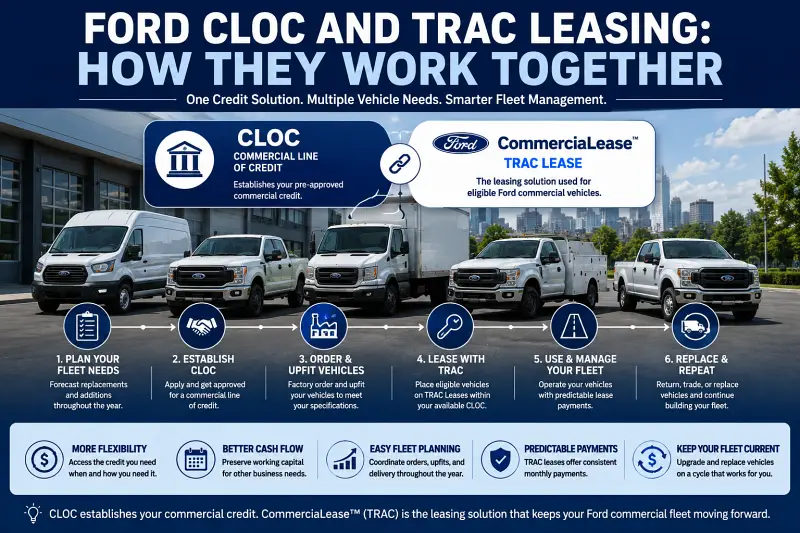
Ford Commercial Line of Credit, or CLOC, can establish commercial credit for qualified businesses, while Ford CommerciaLease TRAC can be used to lease eligible commercial vehicles as those fleet needs arise.
How Do Ford CLOC and TRAC Leasing Work Together?
Ford Commercial Line of Credit is a pre-established amount of commercial credit available to qualified businesses for eligible Ford commercial vehicle purchases and leases.
CommerciaLease is Ford Pro FinSimple’s commercial open-ended TRAC lease product.
When used together, the business can establish a commercial credit relationship first and then use CommerciaLease TRAC for eligible vehicles as replacement, expansion or new fleet needs occur.
CLOC does not replace the lease. It establishes the commercial credit capacity that can support eligible financing or leasing transactions, including CommerciaLease TRAC.
CLOC and TRAC Leasing Do Two Different Jobs
It is easy to confuse CLOC and TRAC leasing because both are part of Ford Pro FinSimple commercial financing.
But they solve different parts of the fleet-financing process.
Ford Commercial Line of Credit
CLOC establishes a pre-approved level of commercial credit for a qualified business, subject to available credit, ongoing eligibility and Ford Pro FinSimple requirements.
It is intended for businesses that expect to finance or lease multiple vehicles over time.
Ford CommerciaLease TRAC
CommerciaLease is an open-ended Terminal Rental Adjustment Clause lease for eligible commercial vehicles.
It provides the actual lease structure for an individual vehicle.
CLOC = commercial credit capacity.
TRAC = vehicle lease structure.
How CLOC Can Support a TRAC Lease Fleet Strategy
The real value of combining CLOC and TRAC leasing appears when a business has several vehicle needs that happen at different times.
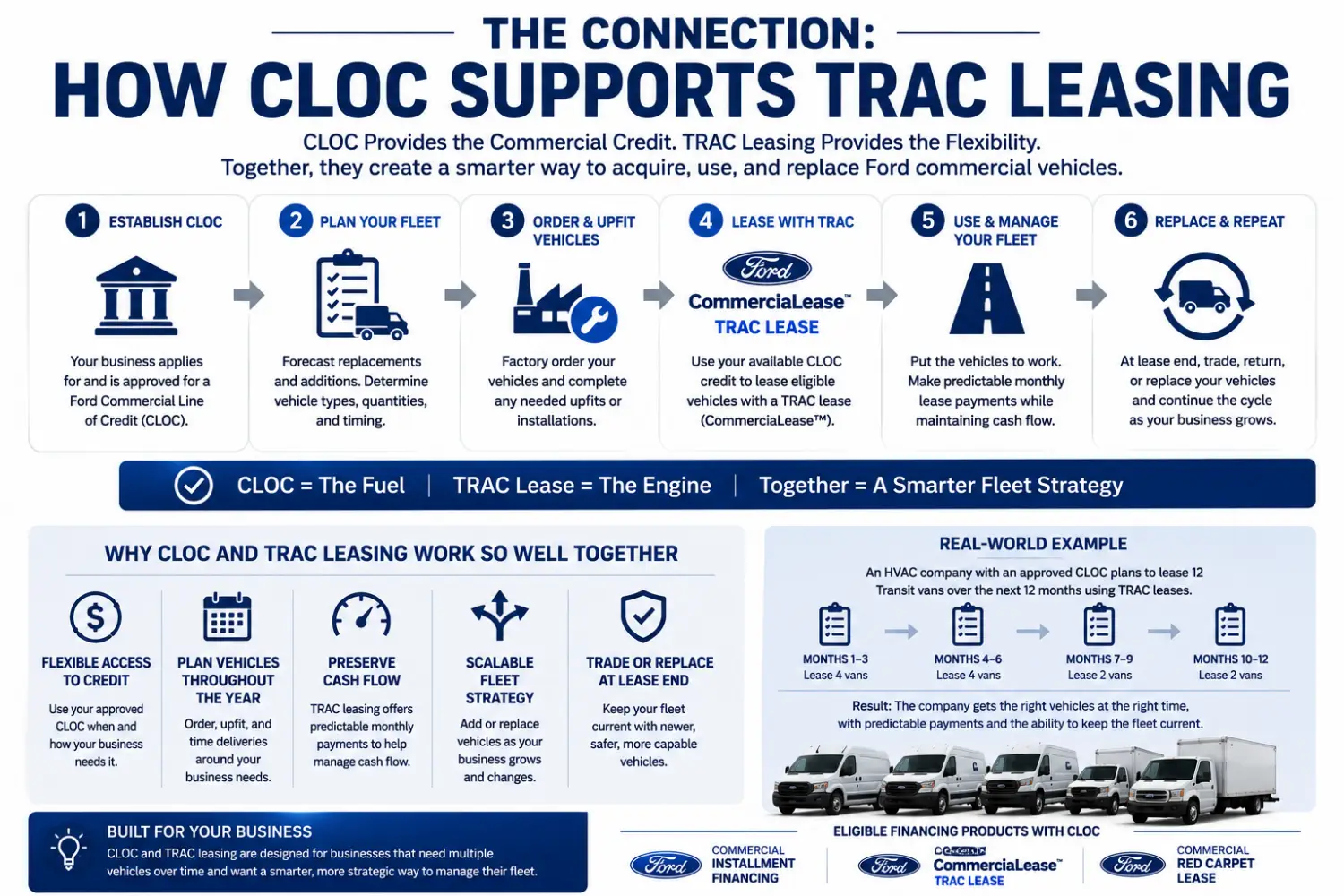
CLOC can establish commercial credit for qualified businesses, while TRAC leasing provides a way to acquire, operate and replace eligible commercial vehicles as fleet needs change.
Start With the Fleet Plan
Before applying for a Commercial Line of Credit, the business should understand what vehicles it expects to need.
Ford’s current CLOC materials indicate that projected vehicle needs are part of the credit review.
The business should be prepared to discuss:
- Current fleet size
- Vehicles approaching replacement
- Expected additions
- Future employee growth
- Vehicle types
- Expected delivery timing
- Commercial upfits
- Expected financing or leasing needs
A good CLOC request should connect directly to a real and explainable vehicle need.
Establish the Commercial Line of Credit
The business then submits a CLOC application.
Ford Pro FinSimple reviews the business, requested credit amount, projected vehicle needs and financial condition.
Ford’s current materials indicate that the review may include:
- Business financial statements
- Commercial credit history
- Payment history
- Time in business
- Industry experience
- Revenue and profitability trends
- Existing fleet size
- Projected vehicle requirements
- Other financial obligations
If approved, a commercial credit line is established subject to the terms of Ford Pro FinSimple’s approval.
Order the Vehicles the Business Actually Needs
Once the broader fleet strategy is established, the company can begin coordinating the vehicles it expects to need.
That may include:
- Factory ordering trucks or vans
- Locating available inventory
- Choosing the correct configurations
- Planning commercial upfits
- Scheduling vehicle graphics
- Coordinating expected delivery timing
This is especially helpful for commercial vehicles because many fleet units require more planning than simply selecting a vehicle from dealer inventory.
Financing, ordering and upfitting should be planned together whenever possible.
Use TRAC Leasing for Eligible Vehicles
As eligible vehicles become ready, the business may choose to use Ford CommerciaLease TRAC within its approved CLOC relationship.
Each vehicle still has its own individual lease transaction.
The lease structure can consider:
- Vehicle cost
- Eligible commercial upfit costs
- Lease term
- Approved rate
- Residual value
- Business replacement strategy
The CLOC provides access to commercial credit. The CommerciaLease agreement determines the terms for the individual leased vehicle.
Not Every Vehicle Has to Be Put on a TRAC Lease
This is an important point.
Establishing a Ford Commercial Line of Credit does not mean that every vehicle acquired by the business must use CommerciaLease TRAC.
Ford Pro FinSimple currently identifies several eligible financing products that can work within an approved CLOC relationship.
Commercial Installment Financing
For businesses that want to finance a vehicle toward ownership.
CommerciaLease TRAC
For qualifying commercial-use vehicles where an open-ended lease and planned residual fit the fleet strategy.
Commercial Red Carpet Lease
A closed-end commercial lease option for qualifying vehicle uses and lease structures.
One business may use different financing products for different vehicles while operating within the same broader commercial credit relationship.
Why CLOC and TRAC Leasing Can Work Well Together
The combination can make sense for businesses with recurring vehicle needs because each tool handles a different part of the process.
Commercial Credit Can Be Planned in Advance
Instead of waiting until each vehicle becomes urgent, the company can establish commercial credit based on projected fleet needs.
Vehicles Can Be Acquired at Different Times
A business may need vehicles throughout the year rather than all at once.
TRAC Can Support Planned Replacement Cycles
CommerciaLease can be structured around a planned term and residual, allowing the business to evaluate whether to keep, sell or trade the vehicle at lease-end.
Commercial Upfits Can Be Considered
Eligible commercial upfits may be incorporated into certain CommerciaLease transactions, subject to Ford Pro FinSimple requirements.
Future Vehicles Can Be Planned Before They Are Needed
Factory ordering and upfit scheduling can begin before an outgoing vehicle is removed from service.
How This Can Support Business Cash-Flow Planning
Businesses have many demands on working capital.
Cash may be needed for:
- Payroll
- Inventory
- Tools
- Equipment
- Marketing
- New locations
- Hiring
- Operating expenses
Using commercial vehicle financing can allow a company to avoid paying the entire vehicle cost in cash at the time of acquisition.
TRAC leasing may also structure payments around a residual value rather than paying the entire vehicle amount down toward ownership during the original lease term.
The objective is not simply to create the lowest monthly payment. It is to make vehicle financing fit the larger financial needs of the business.
An HVAC Company Replacing Vehicles Throughout the Year
Imagine an HVAC company already operates a fleet of Transit vans and Super Duty service trucks.
During its fleet review, management determines that several vehicles should be replaced during the coming year.
The company also expects to hire additional technicians.
Instead of trying to acquire every vehicle at the same time, the business creates a schedule.
New Transit vans can be factory ordered and sent for shelving and ladder racks.
As each vehicle becomes ready, the business can determine whether CommerciaLease TRAC is the appropriate financing option for that unit, subject to available credit and Ford Pro FinSimple approval.
The fleet grows or replaces vehicles in stages instead of turning every vehicle acquisition into an emergency.
Why This Strategy Fits Factory-Ordered Commercial Vehicles
Many commercial vehicles are not purchased directly from available dealer inventory.
The business may need to:
- Select a specific configuration
- Place a factory order
- Wait for production
- Send the vehicle to an upfitter
- Install shelving or equipment
- Add company graphics
- Schedule final delivery
That process can take time.
A business with a documented fleet plan and commercial credit strategy can begin preparing future vehicles before the current units become unreliable or expensive to operate.
Planned credit + planned vehicle ordering + planned replacement can reduce last-minute fleet decisions.
Where Commercial Upfits Fit Into the Strategy
For many businesses, the vehicle itself is only part of the investment.
The truck or van may require:
- Service bodies
- Utility bodies
- Partitions
- Shelving
- Ladder racks
- Storage systems
- Dump bodies
- Other vocational equipment
Ford Pro FinSimple materials state that eligible commercial upfits may be included in certain CommerciaLease transactions and may receive residual consideration, subject to program requirements.
That can allow the business to consider the complete work vehicle instead of treating the chassis and upfit as unrelated expenses.
What Happens When the TRAC Lease Ends?
The strategy does not stop when the vehicle reaches the end of its lease term.
Under Ford CommerciaLease, a business may have options including buying, selling or trading the vehicle, depending on the agreement and circumstances.
The residual position and current market value should be reviewed before the lease-end decision is made.
For companies that regularly replace vehicles, the outgoing vehicle may be traded while a newer replacement is placed into service.
Keeping the Fleet Current
One of the reasons some businesses use a planned leasing and replacement strategy is to avoid keeping commercial vehicles long after they stop making financial or operational sense.
A business may consider replacement because of:
- Increasing maintenance costs
- Vehicle downtime
- High mileage
- Changing business requirements
- New safety technology
- New telematics capabilities
- Fleet appearance
- Employee productivity
A planned CLOC and TRAC strategy can make those replacement decisions easier to anticipate.
The goal is not to replace vehicles simply because they are older. The goal is to replace them when doing so makes sense for the business.
CLOC Can Also Help Businesses With Multiple Locations
A company operating several branches may not have all of its vehicle needs occur at the same time.
One location may need replacement service vans while another is adding employees or expanding into another territory.
A broader commercial credit strategy can help the business plan these acquisitions at the company level rather than treating each location as a completely unrelated vehicle event.
Example
A regional contractor operates multiple branches.
One branch needs new Transit vans, another needs Super Duty service trucks, and a third location expects additional F-150s later in the year.
CLOC can provide the broader commercial credit framework while the business chooses the appropriate financing or leasing product for each eligible vehicle.
What CLOC Does Not Mean
A Commercial Line of Credit can simplify fleet financing, but it should not be misunderstood.
CLOC Does Not Mean:
- Every vehicle is automatically approved
- Every transaction must use TRAC leasing
- The business can exceed its available credit
- Credit approval remains permanent forever
- Every commercial upfit automatically qualifies
- Program terms can never change
CLOC remains subject to Ford Pro FinSimple’s available credit, ongoing eligibility, periodic reviews and current program requirements.
Think of CLOC as a commercial credit framework, not a blank check.
When Does CLOC Make More Sense Than Financing One Vehicle at a Time?
For a company that only needs one vehicle and does not expect additional fleet needs, a broader Commercial Line of Credit may not be necessary.
CLOC becomes more relevant when the company expects multiple transactions.
CLOC May Be Worth Exploring When the Business:
- Already operates multiple commercial vehicles
- Regularly purchases or leases vehicles
- Has several replacements coming due
- Expects company growth
- Plans to add employees requiring vehicles
- Factory orders commercial vehicles throughout the year
- Needs different vehicle types at different times
CLOC + TRAC + Fleet Replacement Planning
The strongest strategy may be when all three are considered together.
Instead of waiting until a vehicle breaks down or becomes too expensive to maintain, the business can build a replacement schedule.
That schedule can then help determine:
- How much commercial credit may be needed
- When factory orders should be placed
- When upfits should be scheduled
- Which vehicles may fit TRAC leasing
- Which vehicles may be better financed toward ownership
- When existing vehicles should be appraised
How Does a Ford FIN Code Fit Into This?
A Ford FIN Code and Ford CLOC are different programs.
A FIN Code identifies an eligible Ford fleet customer and can provide access to applicable fleet programs and benefits.
CLOC is a Ford Pro FinSimple commercial financing tool.
Depending on the business and transaction, a company may potentially use both as part of a broader Ford fleet strategy.
Why Work With a Ford Commercial Account Manager?
CLOC and TRAC leasing work best when the financing strategy is connected to the actual vehicle plan.
A commercial account manager can help review:
- Current fleet vehicles
- Upcoming replacements
- Expected additions
- Factory-order timing
- Available inventory
- Commercial upfit requirements
- TRAC leasing
- Commercial financing
- Vehicle trade timing
The goal is to help the business understand what it needs before the next vehicle becomes urgent.
A fleet financing plan is most useful when it starts with the fleet itself.
Continue Learning About Ford Commercial Financing
Explore Ford commercial credit, TRAC leasing, vehicle upfits and fleet replacement planning in more detail.
Ford CLOC and TRAC Lease FAQs
Can Ford Commercial Line of Credit be used with a TRAC lease?
Yes. Ford Pro FinSimple identifies CommerciaLease, its commercial TRAC lease product, as an eligible financing product that may be used within an approved Commercial Line of Credit, subject to available credit and current program requirements.
Is CLOC the same thing as a TRAC lease?
No. CLOC establishes commercial credit for a qualified business. CommerciaLease TRAC is the individual lease structure used for an eligible commercial vehicle.
Does every vehicle under a CLOC have to use TRAC leasing?
No. Ford Pro FinSimple also identifies eligible Commercial Installment Financing and Commercial Red Carpet Lease products that may be used within an approved CLOC relationship.
Can a business factory order vehicles and use CLOC and TRAC leasing?
A business can plan future factory-ordered commercial vehicles as part of its projected fleet needs. When an eligible vehicle is ready, the appropriate Ford Pro FinSimple financing or leasing product can be reviewed, subject to available credit and approval requirements.
Can commercial upfits be included with a TRAC lease under CLOC?
Certain eligible commercial upfits may be included in a Ford CommerciaLease transaction, subject to the vehicle, equipment and current Ford Pro FinSimple program requirements.
Why would a business use CLOC instead of applying for one vehicle at a time?
CLOC can be useful for businesses that expect multiple eligible vehicle transactions during the year because commercial credit can be established based on broader fleet needs instead of treating every acquisition as a completely unrelated event.
What happens to the vehicle at the end of a TRAC lease?
Depending on the lease terms and circumstances, the business may be able to buy, sell or trade the vehicle. The residual value and vehicle market value are important parts of the lease-end decision.
Planning Several Ford Commercial Vehicles?
If your business expects to replace or add several vehicles over the next year, it may be worth looking at the fleet and financing strategy together.
We can review your current vehicles, expected replacements, upcoming growth, commercial upfits, factory-order timing and financing preferences.
From there, we can help determine whether Ford Commercial Line of Credit, CommerciaLease TRAC, traditional commercial financing or a combination of options may fit the way your business actually operates.
The goal is to have your next vehicle planned before you urgently need it.
Ford Commercial Financing Sources
Ford financing programs and eligibility requirements can change. The information on this page is based on current Ford and Ford Pro FinSimple materials and should be confirmed at the time of application or transaction.
Important: Ford Pro FinSimple Commercial Line of Credit and CommerciaLease are subject to credit approval, available credit, ongoing eligibility, periodic review and current Ford Pro FinSimple program requirements. Vehicle, upfit and financing eligibility can vary by transaction. This page is provided for general educational and fleet-planning purposes and does not represent an approval, guarantee of financing or offer of credit.